I have been reflecting on the notion of glacier sentience.
This idea came after watching the “Requiem for a Glacier” video and hearing of a funeral for a glacier in Nepal. A requiem and a funeral for a glacier and for all glaciers as they melt and fade away with the warmer temperatures brought by climate change.
If a glacier can die, can it once have lived?
If a river can be alive, can a glacier? There is a growing movement to recognize the ‘personhood’ of rivers in Peru, New Zealand, and Canada.
If a glacier once lived, could it have had sentience? How would that sentience take form?
A glacier begins with a single snowflake, unique in its structure, with distinct crystalline patterns. Each snowflake is an individual, never repeated, accumulating with countless others.
The accumulation of snowflakes becomes a repository of possibilities of diversity and interconnection. Diversity recording the air composition, the temperatures, the conditions of long past environments.
As more snowflakes accumulate, they compress under their own weight. With pressure, they transform into glacial ice crystals.
This ice forms layers within the glacier. The top layer is brittle and new, cracking as it moves over uneven terrain like cliffs and boulders. The middle layer is denser with layer upon layer of a history of snowflakes. A history of crystalline diversity and trapped air bubbles. A record of air composition through the millennia.
The bottom layer, subjected to intense pressure, becomes very plastic. This plasticity allows the glacier to flow and move downhill, from where the snowflakes originally fell, possibly hundreds or thousands of years ago.
The thousands of glaciers in Nepal, the Himalaya, and globally, including my home country of Canada, are rapidly melting due to rising temperatures. Glacier preservation requires reducing CO2 emissions.
In the Himalaya and HinduKush, glaciers that are the primary source of water for downstream communities, have been melting at an alarming rate in recent years, posing a significant threat to the region’s livelihoods, biodiversity and ecosystems.
With March 21 becoming the World Day for Glaciers, it serves to raise awareness of the critical role of glaciers, snow, and ice in climate systems, and the economic, social, and environmental conditions of communities and nations.
A letter arrives saying that a friend in Canada was killed in an accident. It asks me to arrange to have some prayers done for Nina.
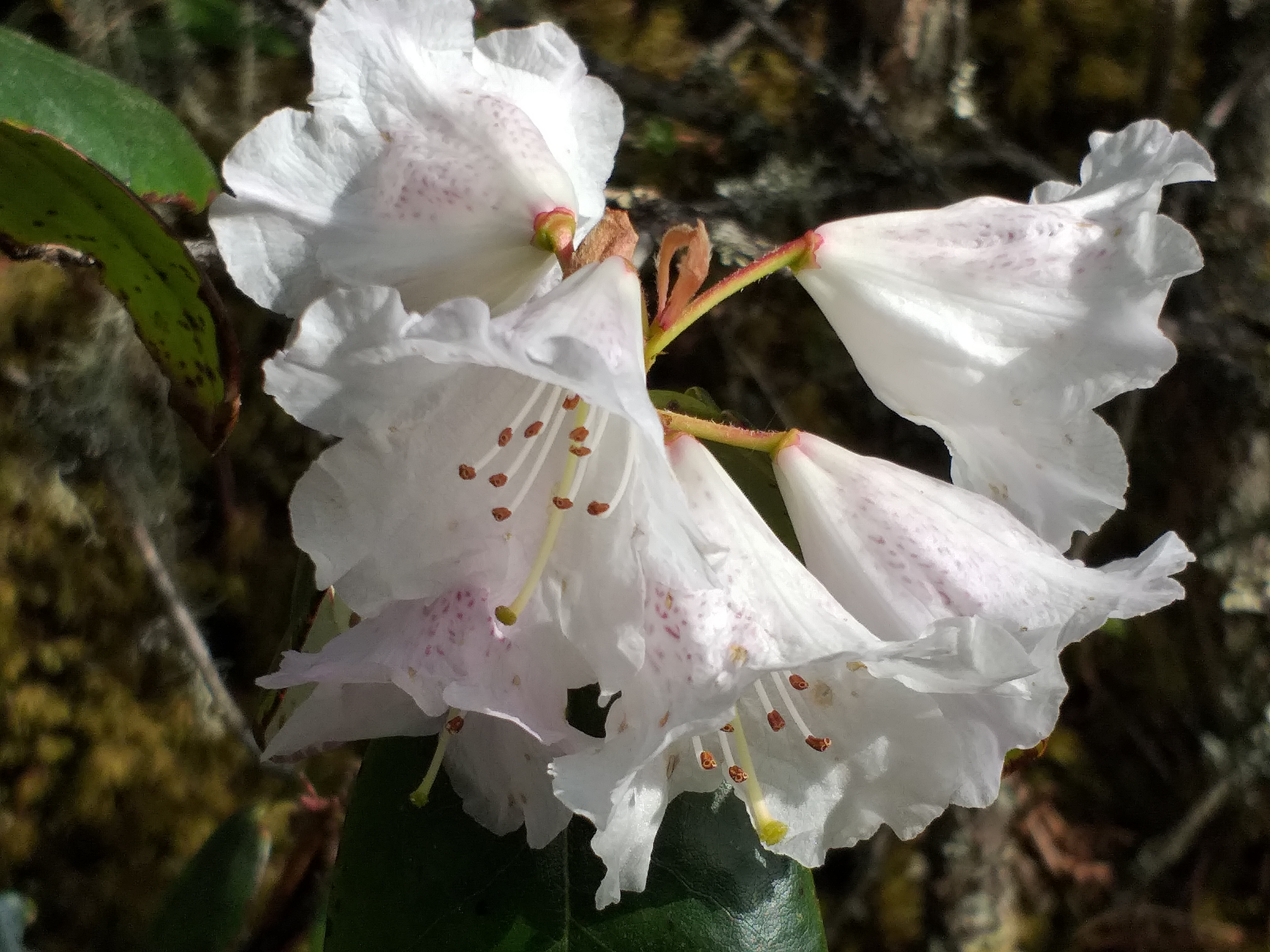
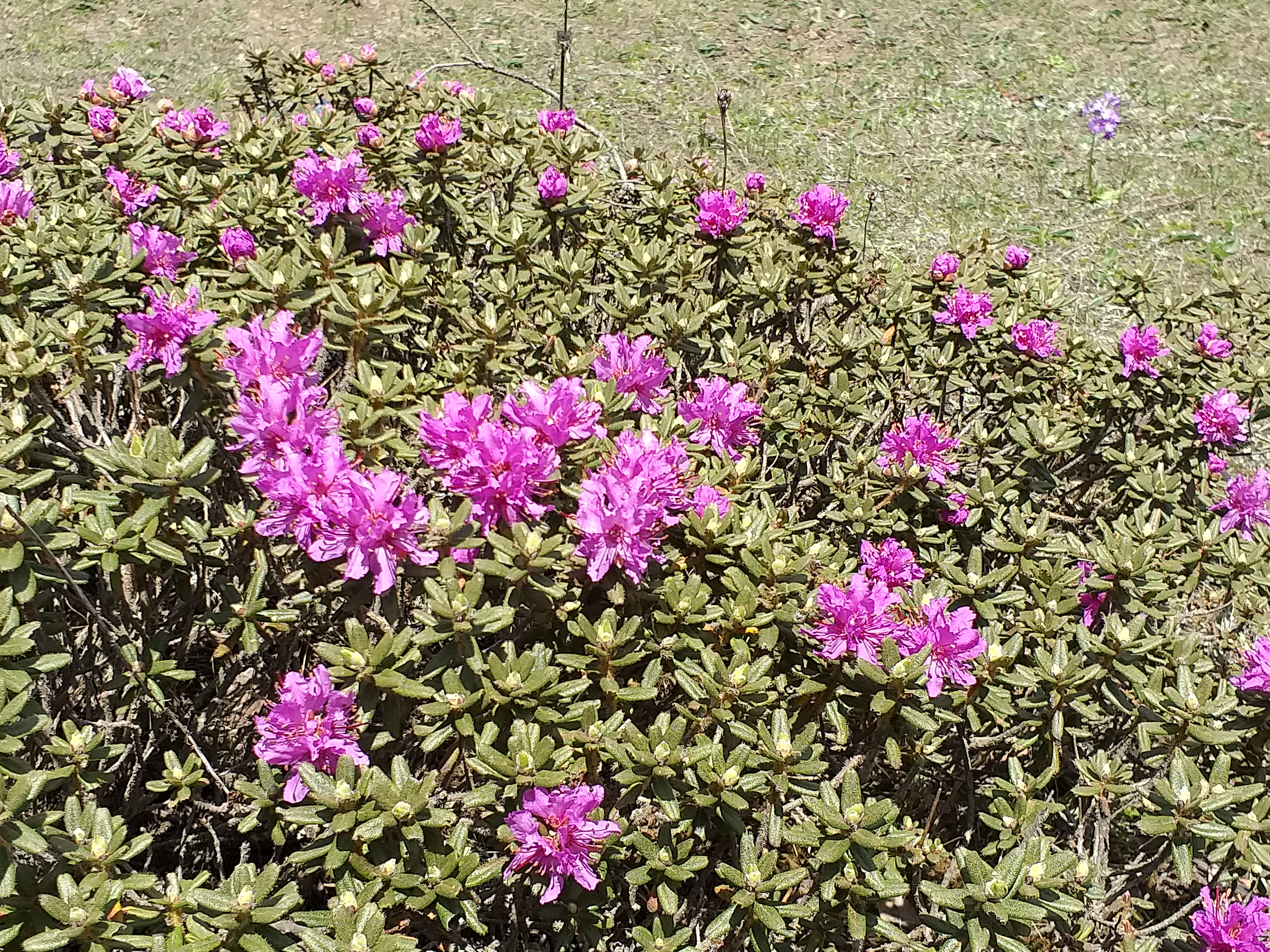
The monks at Tengboche are busy, but someone suggests the anis (nuns) at Devuche, the little nunnery twenty minutes’ walk away. Devuche sits in a meadow at the edge of the rhododendron forest in a quiet, peaceful place.
At Devuche, I arrange for the anis to say some prayers the next day. However, in the morning, only the abbess and one elderly nun are present in the kitchen.
The abbess hands me some of the 50-rupee notes I had given her the day before. “Take this to the blind ani who can’t come do the puja (prayers) in the gonda but can say prayers. Take this to the ani in this house right here who is in retreat.”
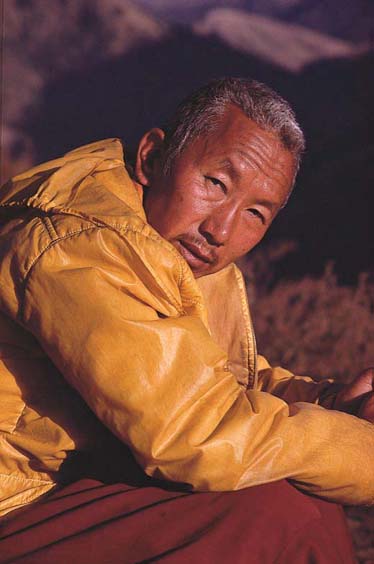
I knock on the door of the ani in retreat. An elderly person wearing robes and a traditional winged yellow hat opens the door. I ask, “Would you please say some prayers for a friend of mine who died 49 days ago?”
She gestures for me to enter. Her small home is clean and tidy. I sit on a wide bench stretching across the end of the room while she prepares tea on the little clay-lined, one-pot burner. She asks the name of my friend who has died. “Ni-na,” she repeats as she notes it down in Tibetan script on an envelope.
“How long have you been in retreat?” I ask.
“Twenty years,” she pauses, “and thirteen years. For this time, I have not left this little compound.
“I am from Nauche. My family did business in Tibet. When I was eight years old, I first went to Rongbuk. There I received a blessing from Zatul Rinpoche and took my first vows to become an ani with Tulshi Rinpoche.
“When I was twenty, I was here in Devuche and had been an ani for several years. A rich man from Solu wanted another wife after his first passed away. He first sent one and then two men from Solu to Nauche to ask my mother in Nauche while my father was in Tibet trading. She sent them away.
“Then, he got several men together — about 11 of them just to come get one woman. They surrounded my house here in Devuche. I went to bed but could not sleep. Finally, I escaped out a window late at night and hid in the river gorge.
“They looked in the woods and all the houses. I hid by the river for two days and on the second night wondered what to do. I had no food, no shoes, just the robe I grabbed as I crawled out of bed.
“Finally, I worked my way along the river and up through the forest to Tengboche. Rinpoche could not hide me there, because monastery rules do not allow women to stay.
“A man who had just come from Tibet a year before agreed to help me. We hid in the day and travelled at night through Thame and over the pass to Tibet. In those days it took four days to walk across the Nangpa La (pass) to the first village in Tibet, then ten days to Shigatse and ten more to Lhasa. I stayed there for ten years until I was thirty.
“When the Chinese became really strong in Tibet, I was studying at a nunnery higher in a valley. Rinpoche and his half-brothers were at a monastery nearby. They came to see me. We decided it was time to return to Nepal. I came to Devuche and started my retreat.
“For six weeks after I arrived here in Devuche, we did not know if the Dalai Lama was alive or dead. Then finally one day I heard that he was in Kalimpong. What a relief.” As I stand up to leave, I pull another 50-rupee note from my wallet. “Would you also please do some prayers for the book I’m working on?”
Ani-la holds the bill thoughtfully for a moment before setting it on the windowsill among her papers.
“People always come and ask me to say prayers for this and for that. So their son will get into this school or that this business venture will be successful. They do not understand that when these prayers bring about general good fortune or merit, it comes from within, from within themselves.”
She hands me a paper and a pen.
“I want you to write down these prayers so you can say them yourself for good things to happen. Om Ah Hung Betza Guru Padme Siti Hung is to Guru Rinpoche. The next is Om Mani Padme Hung to Chenresig. Om Ah Mi De Wa Hri to Opagme.”
I obediently write down the mantras as she hovers above me in her winged cap. “Say 108 of each mantra. Say them every day if you can. As you say them, always think of going to the place of the gods, but always remember…”
She reaches out and touches my chest. “Always remember that the gods are right here within you.”
Most everyone has heard of the Sherpas through the literature of mountaineering. This awesome reputation however, focuses on a single vocation rather than on the Sherpas’ rich cultural heritage.
The Sherpas originated as several families who migrated from eastern Tibet and settled uninhabited valleys in the Himalaya about 400 years ago. Their name “Sher-pa” reflects those origins: “east-people”. This small group of families brought with them the rich traditions, religion and literature of Tibetan Buddhism.
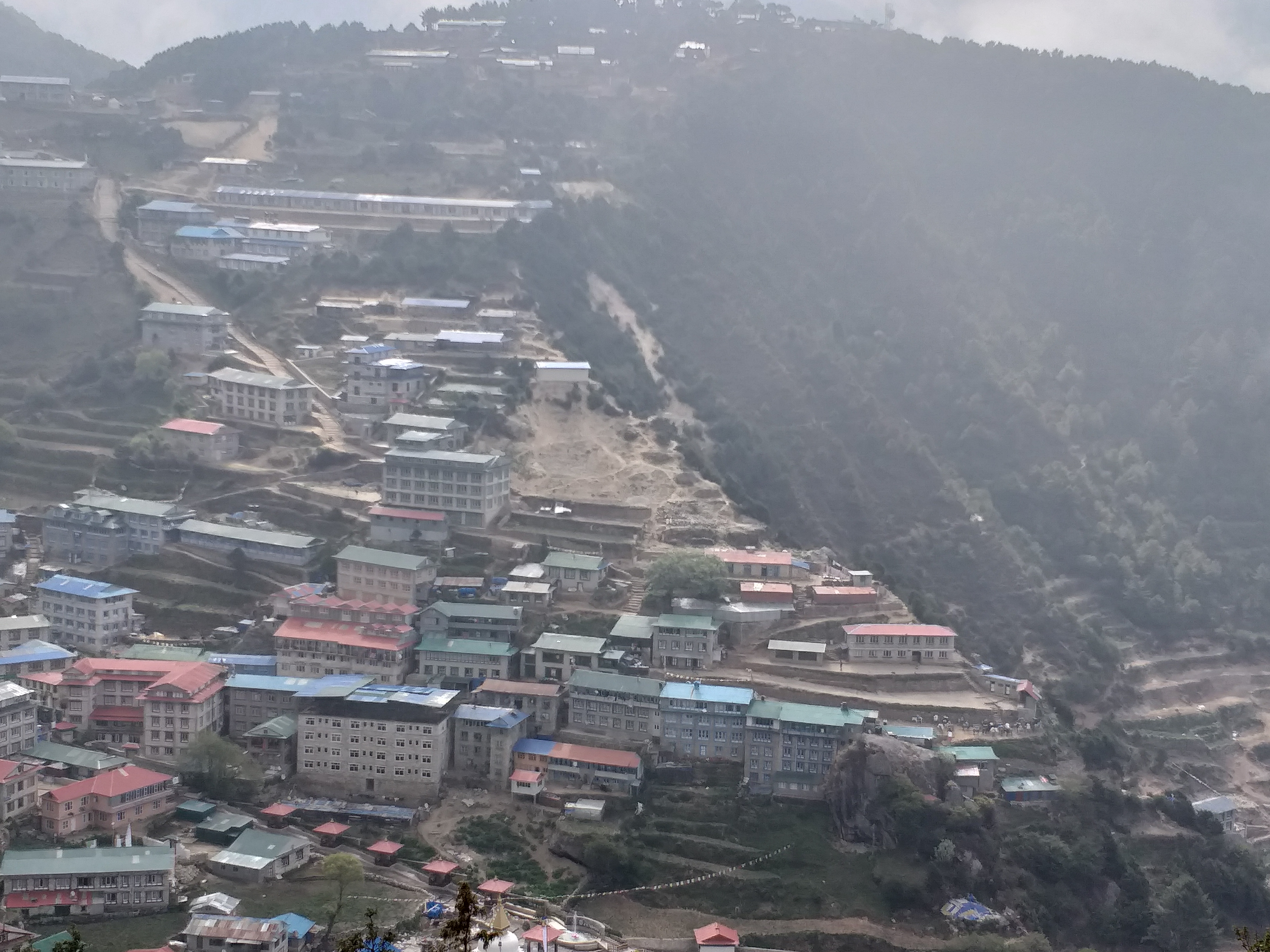
The Sherpas built their houses on any landform flat enough for agriculture, such as the ancient hanging terrace of Phortse, the glacial trough of Khunde and Khumjung, and the bowl-like valley of Namche. Their villages face south for more favorable growing conditions, and lie between 7,000 and 15,000 feet above sea level. Most Sherpas have a home in one of the main villages of Khumjung, Khunde, Thamechok, Namche, Pangboche, and Phortse, but often stay seasonally in huts at the high pastures.
Hard Livelihoods
Here, the cold climate allows the Sherpas to cultivate only one harvest a year from their rock-strewn fields. To survive in this formidable environment, the Sherpas have always engaged in another livelihood whether trading across the Himalaya or migrating in search of employment.
For much of the late 1800s and early 1900s, Sherpas migrated in search of employment to British-ruled Darjeeling. Sherpa men first worked as high altitude porters on British attempts to scale the great peaks of Sikkim in 1907, and have worked on every major Himalayan mountaineering expedition since then. Mountaineers praised the Sherpas’ friendliness, loyalty and dependability. Eric Shipton was a British “explorer” of the Himalaya in the 1930s-1950s. He described the Sherpas:
“It is the temperament and character of the Sherpas that have justified their renown and won them such a large place in the hearts of the Western travelers and explorers who have known them. Their most enduring characteristic is their extraordinary gaiety of spirit. More than any other people I know they have the gift of laughter.”
Sherpa Village Life
Surviving in these mountain settlements requires community effort
Community norms and rules traditionally regulated everything from the collection of fuel wood and leaf-litter, to the movement of the yak herds, to the performance of cultural rituals and festivals. Members of the community are still elected to three positions that manage agriculture and grazing, forest use, and cultural life. They have the authority to impose fines on villagers who break the traditional rules, called the “dhi.”
Sherpas raise yaks and grow potatoes as their staple products
In the valleys of Khumbu, the summer monsoon lasts from June to September. During this quiet but productive season people carry out their chores of herding and farming. Farming is not easy on these mountains, but all, including businessmen, own plots of land on which they grow potatoes, buckwheat or barley to feed their families.
Most fields for cultivating food crops are at relatively lower elevations of about 3300 meters near the main Sherpa villages. During the cool winter, herds of yaks are grazed on nearby hillsides; when the summer comes, the yaks are taken up to high valleys where the rains have changed the dry mountainsides to rich, green pastures.
Sherpa families use these valleys as summer pastures for their yak (male) and nak (female) herds. Pheriche, Dingboche, Lobuche, and Gokyo were established as their summer huts and hay fields. The shaggy bovines provide dairy products, wool, and transportation. Sherpas call the male crossbreeds dzopchioks; they are sterile and are used as pack animals, especially on trips down to the warmer elevations that the high-altitude yaks can’t tolerate. Female crosses are called dzooms. They produce milk that is almost as rich as a nak’s, and in greater amounts.
Changes in Sherpa Livelihoods
From Trading across the Himalaya to Global Tourism
As a people, the Sherpas have historically responded and adapted to changes brought by the outside world. In the mid-1800s, the Nepali government granted the Sherpas a trade monopoly by prohibiting anyone but a Khumbu Sherpa from crossing the Nangpa La, the 19,000 ft pass into Tibet. Many Sherpa families benefited to some degree from the bartering that took place in either Tibet or the border towns of India.
Namche was been the main trading centre since 1905. Prior to that, it was simply a place where traders from Khumjung stored their trading goods between the seasons when they could cross the pass to Tibet and when they could travel to the lowlands. The trade to Tibet was drastically reduced after it was taken over by the People’s Republic of China in the late 1950s.
At present a few Tibetan and Sherpa traders cross the pass in both directions. They can be seen at the weekly market along with lowland Nepali traders. The weekly market is not a Sherpa tradition; it was started in the mid-1960s by an army officer stationed in Namche to meet the needs of the growing population of Nepali civil servants.
The Sacred Valley
For centuries, the Khumbu Valley has been a sanctuary
To the first Sherpas, the Khumbu Valley was unique and special as a “beyul”, a sacred valley that was set aside by Guru Rinpoche, the founder of Buddhism, to be a refuge in times of trouble.
When the Sherpas came here about 400 years ago, they were escaping political changes in eastern Tibet. They may also have been migrating at a time of climate change. The Abbot of Tengboche monastery tells of the Sherpas coming at a time when “the glaciers were much bigger, and Khumbu was covered with snow.
Hence, their first settlements were down near Lukla. As the snow and ice gradually melted, people gradually founded villages at Khumjung and Pangboche.”
At that time, the rivers had no bridges, the cliffs had no steps; there were no footpaths, no dwellings, no fields of grain, no woven cloth, no cows to milk. These first settlers transformed the landscape into agricultural fields and pastures for cattle.
However, people may have been visiting the valley well before the arrival of the Sherpa people. In fact, oral traditions hint that Rai shepherds may have been using the Khumbu’s high pastures well before the Sherpa, and old ruins in the valley are said to the remains of Rai shepherd’s huts.
Prayer Flags Over Tin Roofs
The Sherpa religion came through the oldest sect of Tibetan Buddhism, the Nyingmapa, which was established about 1,240 years ago. The Sherpa history and teachings are recorded in Tibetan script and their language is a dialect derived from Buddhist books. Traditionally, these books were stored in each village’s temple where lay ministers, lamas, would conduct ceremonies and teach religion to the local people.
The power of nature is embodied in protective gods. For example, Jomolungma resides on Mt. Everest. Qualities such as wisdom and compassion are also visualized as deities to help one concentrate while meditating. Prayers to them may influence important events and daily activities. Weddings, funerals and births are accompanied by pujahs of offerings and prayers.
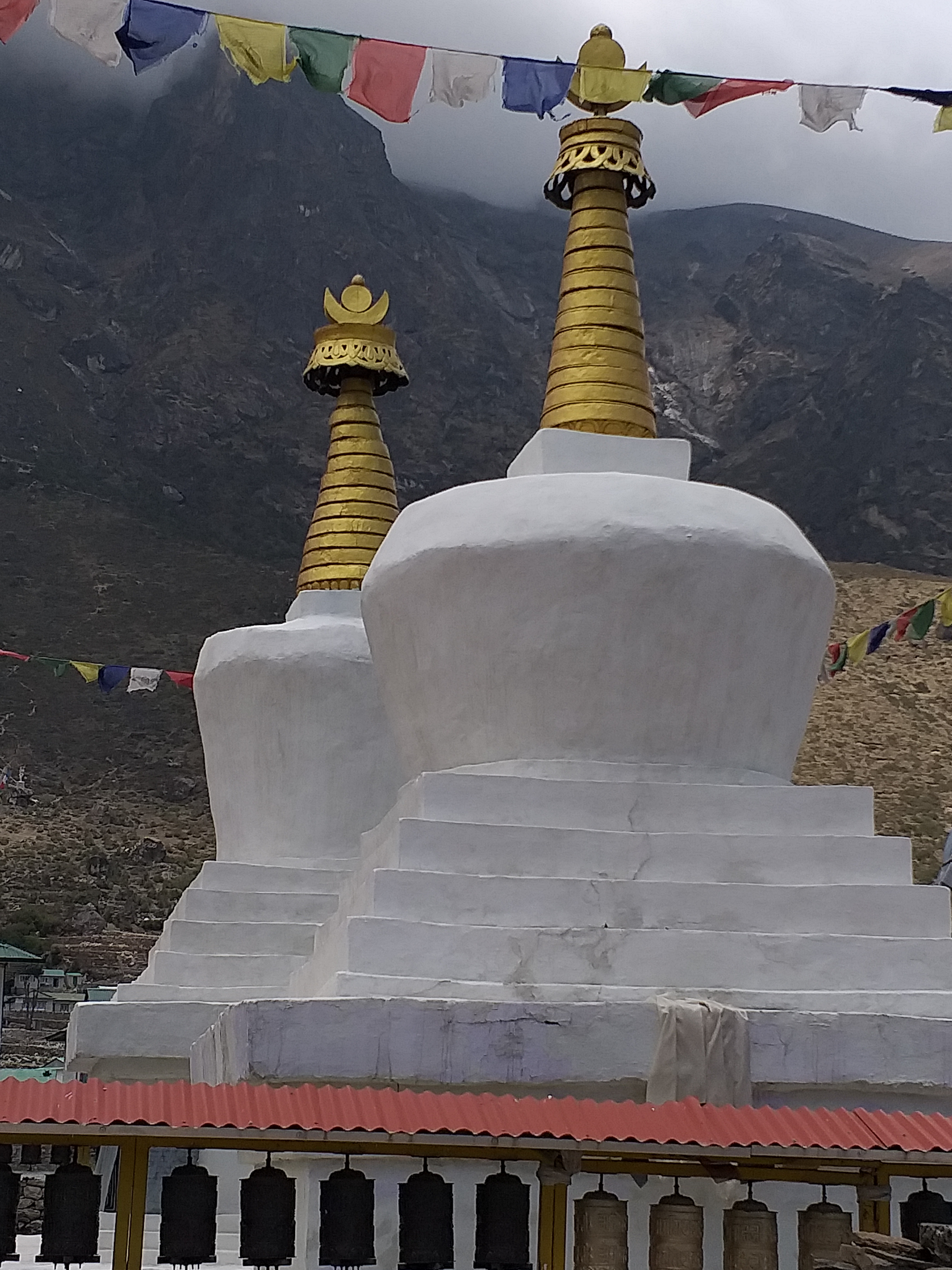
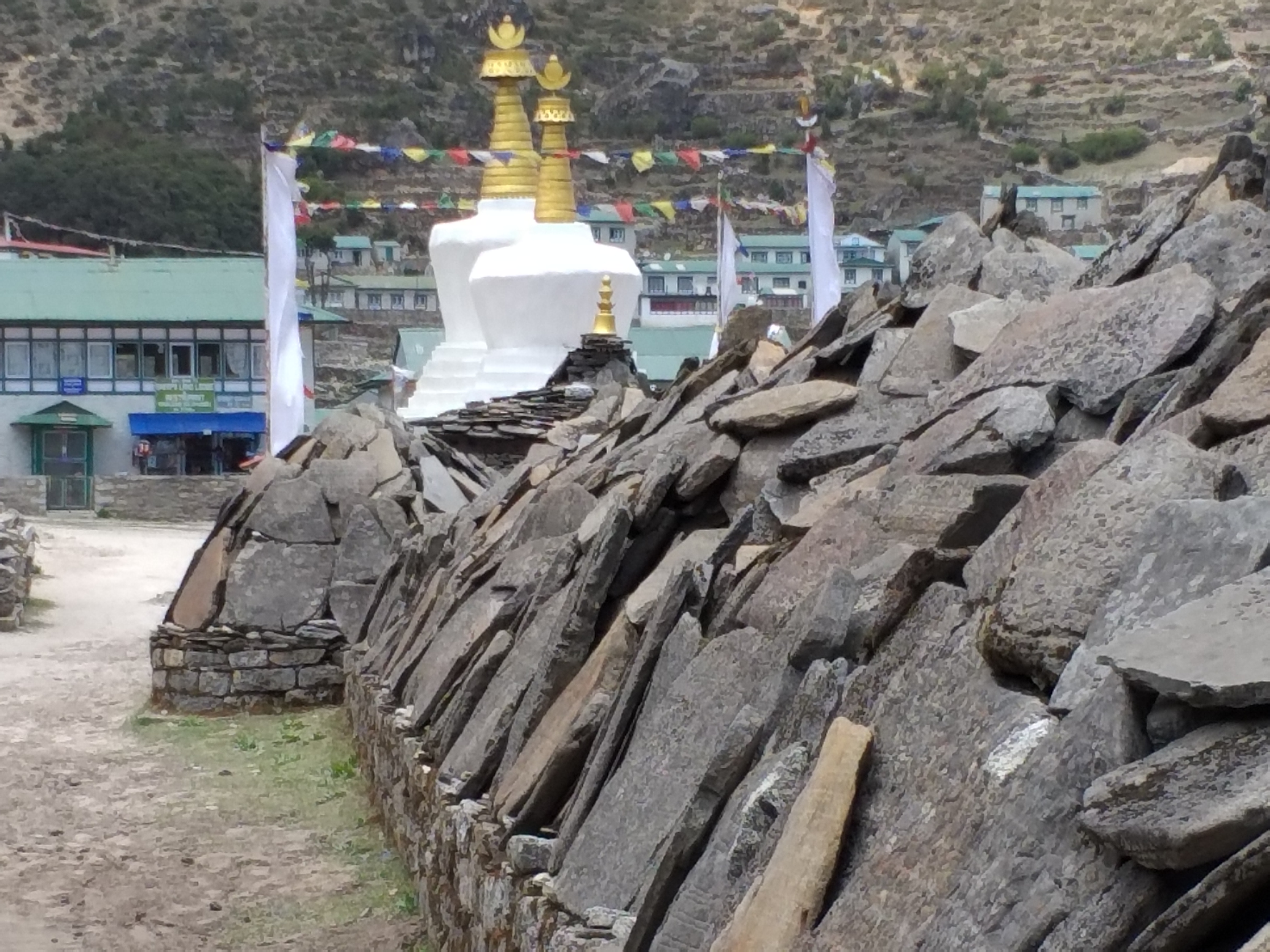
Anyone may build a religious monument or object and so gain spiritual merit. The thoughtful offerings of those who made them are multiplied by each flutter of the prayer flag in the breeze, each turn of the wheel, each traveler’s respectful gesture.
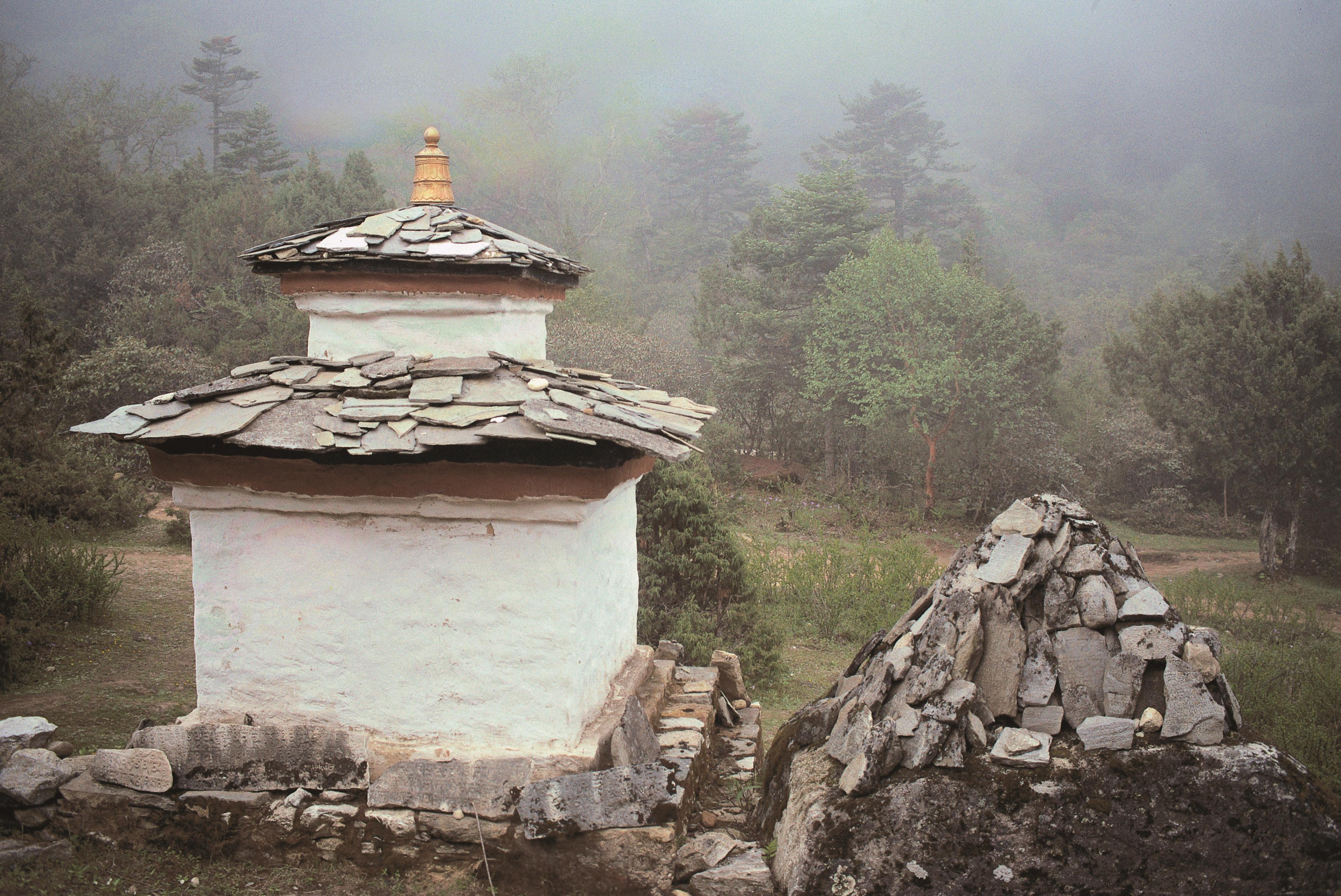
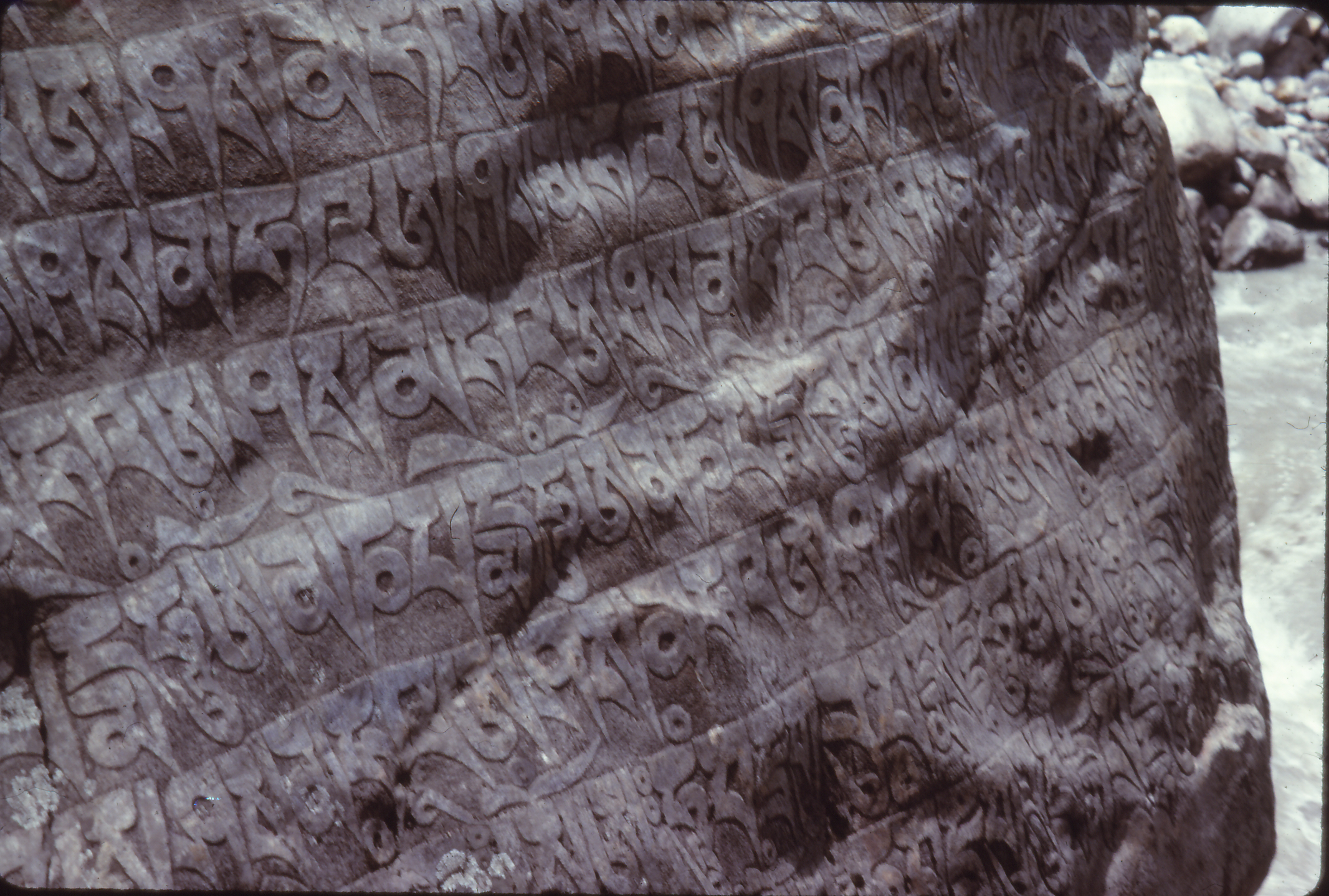
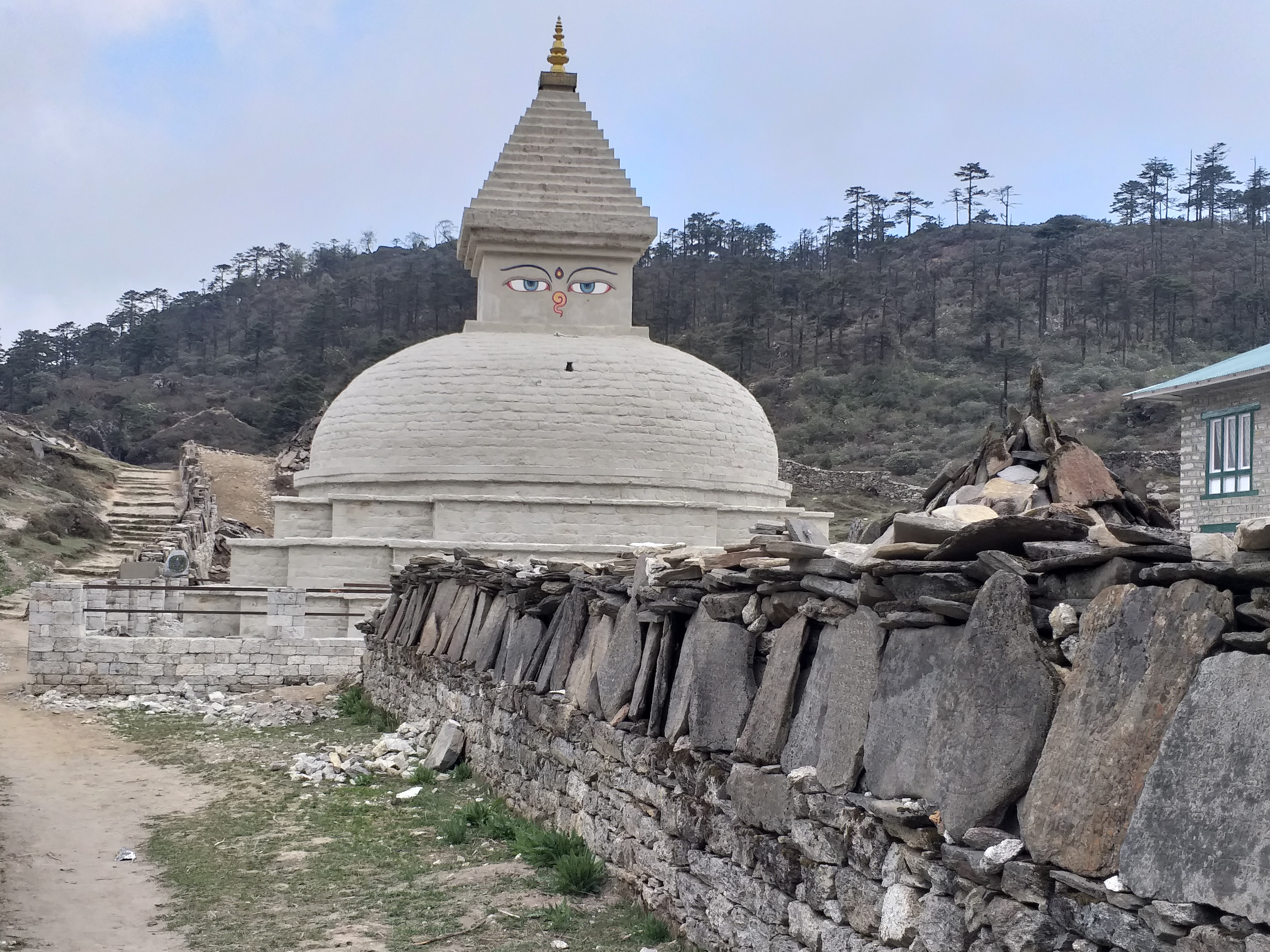
MANI STONES are found near paths, temples, villages and homes. They may be carved with a single mantra (chant) or a complete prayers to the god of compassion.
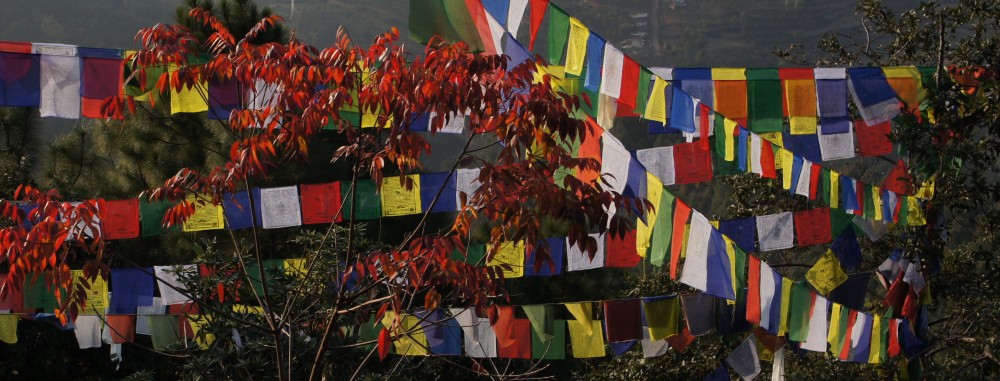
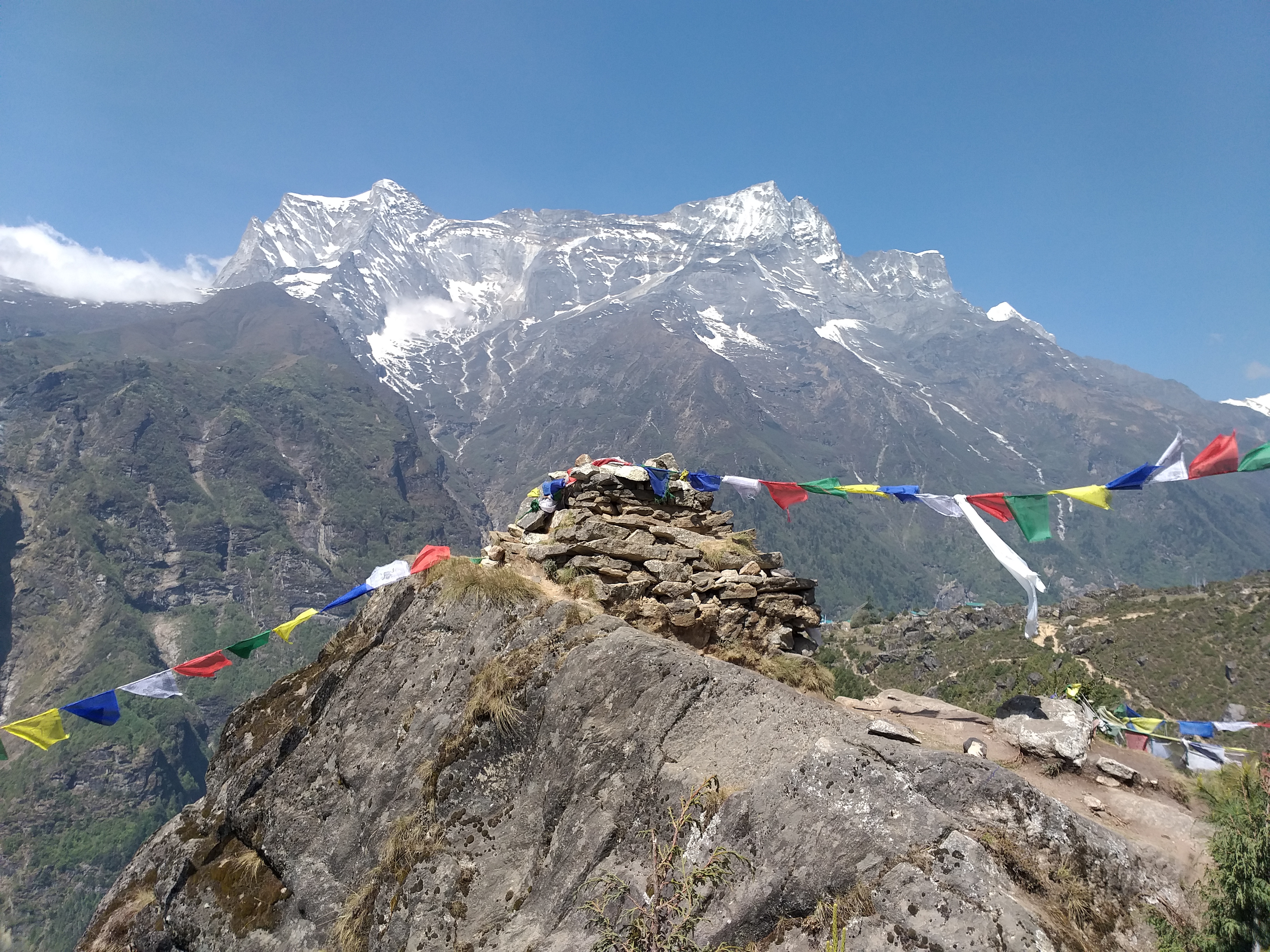
PRAYERS FLAGS are on roofs or mountain passes, strung across rivers and paths, or on tall poles. The five colours of prayer flags signify the elements; yellow, earth; red, fire; green, wood; blue, sky and water; and white, iron.
SONY DSC
Sagarmatha – Jomolungma – Everest
This mountain of many names has always attracted pilgrims, whether Tibetans honoring a peak they believe is the abode of a deity, or climbers and trekkers fascinated by the highest point on earth. Sagarmatha is the name given by the Nepali government in the 1970s and the name Everest was given by the British in India.
“Jomolungma is the name of the mountain. Jomo Miyo Lang Sangma is the name of the resident female deity. She is a mother goddess and one of the five sisters of long life, so many pilgrims used to go to see her in Tibet. Now, people, from all over the world, come to see Jomolungma, from Khumbu.”
“Jomo Miyo Lang Sangma rides on a red tiger. This goddess is very pretty; she is orange and bright looking. She wears a garland of flowers around her head and robes of many colors. In Jomo Miyo Lang Sangma’s right hand is a long bowl of food and in her left a mongoose that spits wealth.” – The Abbot and Reincarnate Lama of Tengboche Monastery
Tengboche Monastery has been the heart of Sherpa culture since 1916
The Sherpas only started to establish celibate monasteries in the early 1900s. Tengboche was the first celibate monastery in Solu-Khumbu and is a community of about 30 tawas (monks) under the leadership of the Abbot, Tengboche Rinpoche (Reincarnate Lama).
Construction of the monastery’s gompa (temple) started in 1916 and lasted three years. The gompa has been destroyed twice, by an earthquake and a fire. The 1990s reconstruction of the gompa attracted the support of Sherpa and international communities to this once isolated monastery
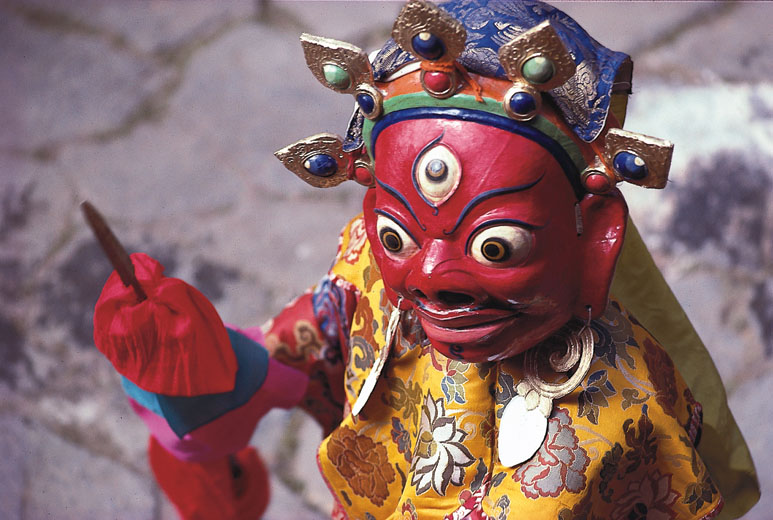
Tengboche is also known for the masked dances that celebrate the completion of ten days of prayers for the good of all beings. For the Sherpas who come from many villages to attend, Mani Rimdu is a relatively recent tradition that started at the opening of Tengboche monastery in 1919.
It is performed at Tengboche monastery in the ninth month of the Sherpa calendar, which usually falls in November and at the Thame monastery in the fourth month.
There are 16 dances performed at Mani Rimdu. Tengboche Rinpoche explained the dances: “Certain movements, sounds, smells, and sight can awaken our psyche and stimulate the states of awareness we describe as gods. The dances are meditations that portray the gods and generate merit for everyone.”
Outer Changes and Inner Stability
The coming of tourists to the Khumbu Valley has brought outside changes and opportunities
Since the Nepali government first allowed westerners to visit the kingdom in the 1950s, the coming of tourists from around the world to see the highest mountain has brought a variety of changes both enhancing the livelihoods of the Sherpa people and affecting other cultural and natural aspects of Khumbu.
Tourism has grown to be the main source of livelihood for the Sherpas. Since 1983 to 2019, the number of trekkers coming each year grew from 4,000 to 55,000. The number of hotels in Namche grew from 5 to 100. It was only since 1995, that families started constructing buildings to be used as hotels on the north facing area of the village.
Certain families and communities have had opportunities for education, loans, travel, and prosperity. Others struggle with the inflation created by the growing demand for food brought by the annual increase in tourists. Yet, the tourism economy of Khumbu sustains households as far away as ten-days-walk to the south east.
In Sherpa agriculture, potatoes are still dug by hand, and the traditional rules still regulate the annual herding of yaks.
Changes in the Khumbu Valley include the bridges and trails. Infrastructure growth has occurred in villages along major trekking routes with changes in traditional building materials. The Lukla airstrip was built in 1964 to facilitate the construction of the hospital in Khunde by the Himalayan Trust. In 2019, over 55,000 passengers flew in or out of Lukla, and hotels and services have been developed to serve them. Benefits include the places where the national park plantations have transformed bare hillsides to small forests.
While contact with outsiders has brought modern amenities, the Abbot of Tengboche monastery considers the changes in Khumbu: “There are outward changes in our dress, houses, occupations and opportunities. However, contact with westerners has not necessarily changed the Sherpa culture in terms of ‘inside’ culture – in what they believe and celebrate. Sherpas, young and old, all do pujahs for naming children, weddings and funerals. We celebrate Dumje, the Sherpa new year, and other festivals. What is most important to us remains.”Part 3: The Wheel of Life
Sherpa religious and cultural rituals are generally unchanged for the important events of life: birth, marriage and death
The “inside culture” of the Sherpas – how they mark life’s and the year’s important passages – remain relatively unchanged despite the obvious changes to “outside” aspects such as houses, clothes, and educational and economic opportunities.
Many households and communities will schedule important activities whether travel, rituals, weddings, and funeral rites on auspicious days of the week, lunar month, and year.
The genealogy of the Sherpa follows clans that descend through one’s father. Tradition stipulates that one cannot marry within one’s own clan. Marriage with someone from one’s mother’s clan is permissible, if the couple is not related within three generations. Sherpas still strictly adhere to these proscriptions.
Sherpa Weddings
Wedding traditions are still followed very strictly in Khumbu and with minor modifications among Sherpas living in Kathmandu or even abroad. There are several stages to a Sherpa wedding. Sodene is the asking or the engagement. Demchang is the establishment of a proper agreement. Trichang sets the year and month of the final ceremony; Pechang is the consultation that sets the actual date. Zendi is the final ceremony where the woman comes to live with the man. The bride’s family gives presents and property that is her inheritance from them.
Sherpa Funerals
The Sherpa funeral rituals are strictly adhered to whether the deceased resided in Khumbu or Kathmandu. When a person dies, lamas are called immediately to perform rituals to try to generate good, positive energy for the deceased. There are many different customs, but, usually, the body is kept for three days then cremated. The remnants of the fire mixed with clay and are made into tsatsa that are left in a chorten or under a large rock at the end of 49 days.
Every seven days after the death, special prayers are offered in the home of the deceased. Within three or four weeks, the prayers called Shitro are done for three to fifteen days, depending on the finances of the family. Every evening the family places an offering of tsampa on the fire’s hot coals for the spirit of the deceased. The Bar-do for 49 days after the death is the time and space between lives, by the end of which the person’s next life is determined and they may be reborn.
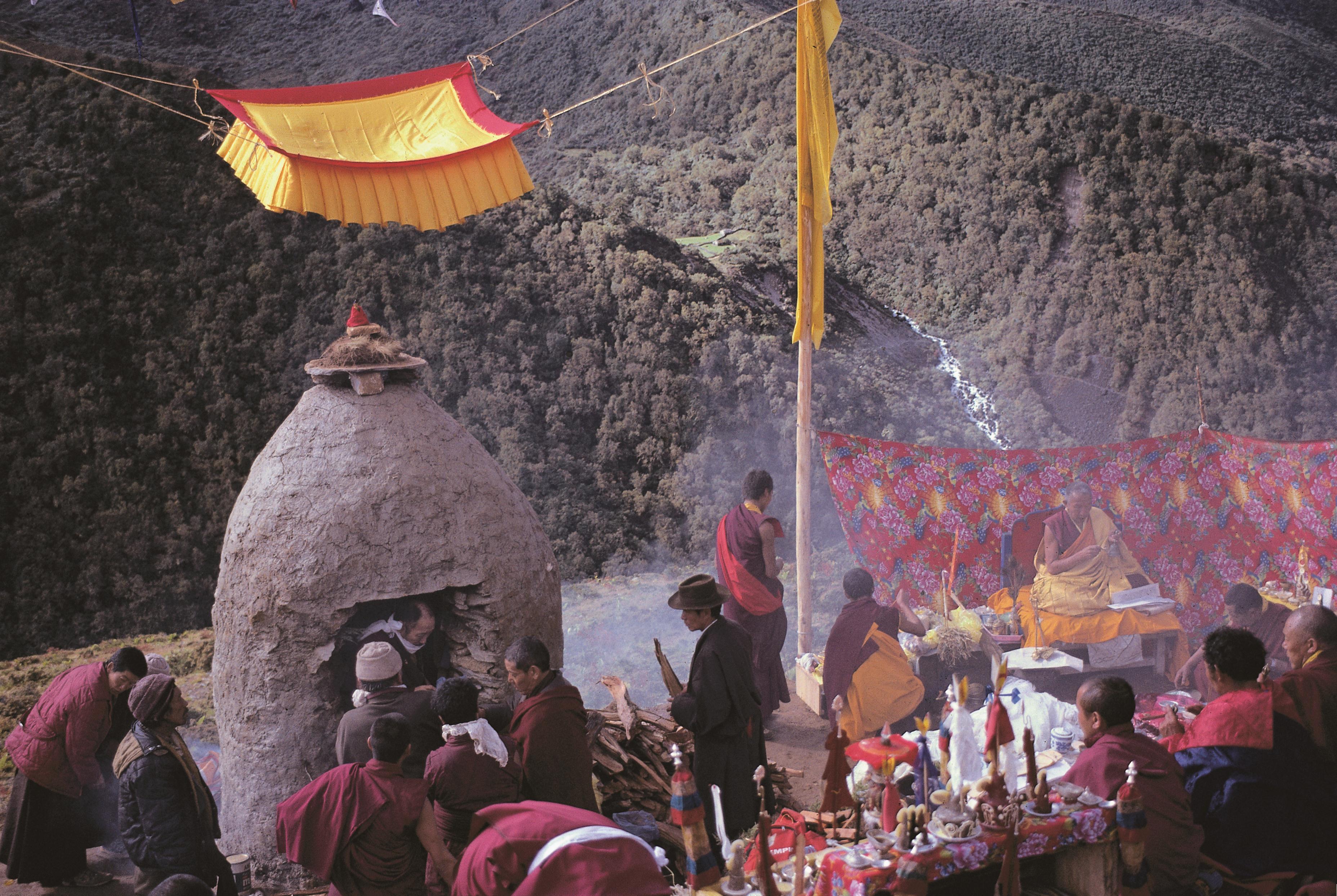
Special rituals are performed for high lamas and rinpoches, and the body is cremated in a special chamber.
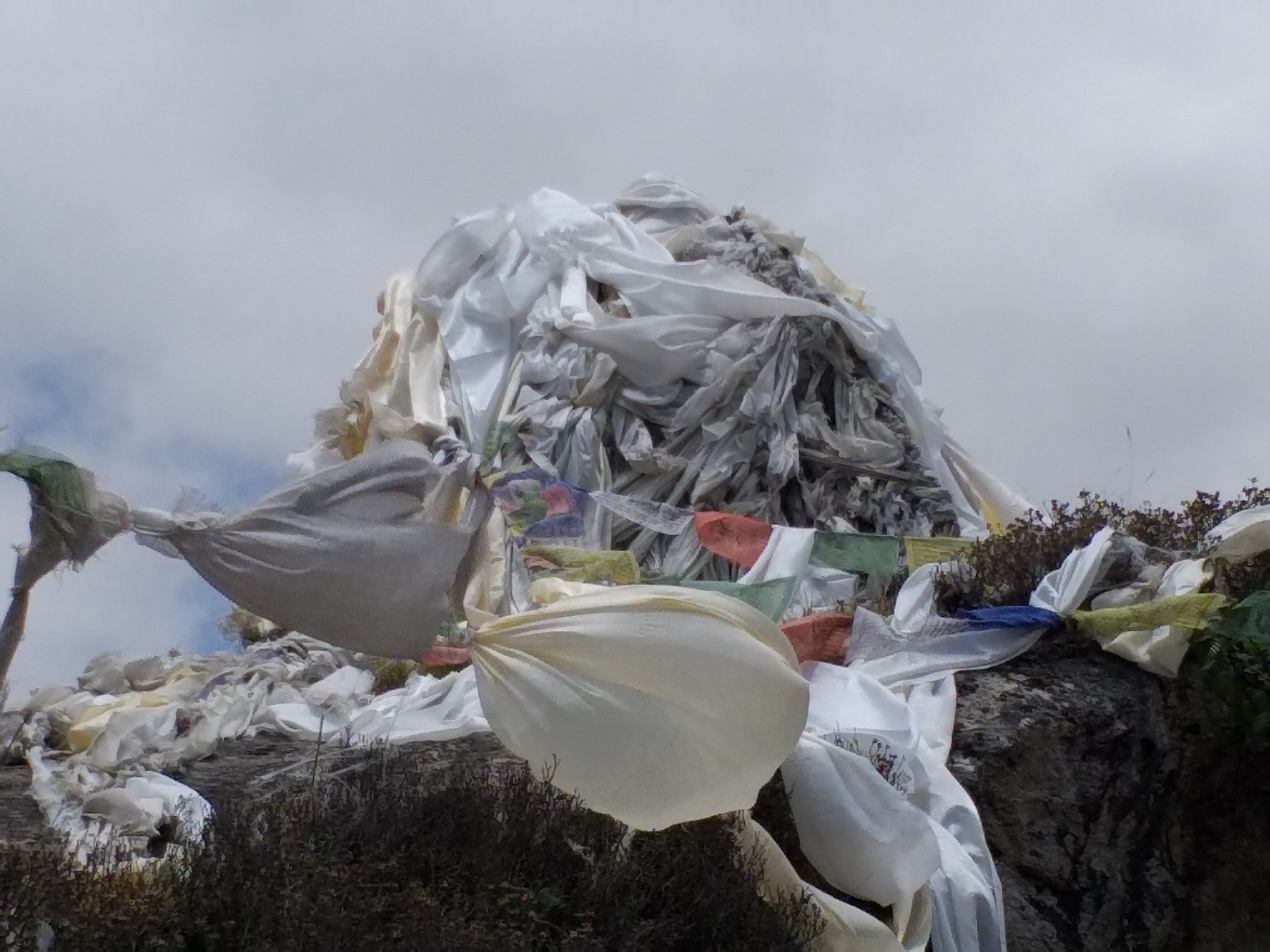
These photographs are of the cremation of Dhui Rinpoche, a very important teacher who passed away in 1989 at the age of 86. On the day of his cremation, his body was carried up the mountainside to a prominent ridge.
His funeral was a celebration of an accomplished lifetime. Over seven hundred people came from as far away as six days walk. His body was placed in the stone monument to be cremated as an offering.
Dumje Festival – A celebration of community spirit
The Sherpa year revolves around the main festival of Dumje celebrated in each village at the beginning of the monsoon in late June or early July. Dumje began as a way to unite the newly settled villages after the Sherpas arrived in Khumbu.
Each year, eight households in a village have a turn, which comes about every sixteen years, to sponsor the festival. Each sponsor provides food for the festivities according to their means. Though this huge financial obligation may cause less affluent families to borrow substantial sums of money from lenders, most families see Dumje sponsorship as a worthy community involvement.
While in the past men from the village who had some religious training would prepare for the rituals, now the village invites and hires specialists, monks from the monastery to come and help prepare for the celebration. Also whereas in the old days, the most learned of the lay lamas (ministers) would officiate and lead the prayers, now the heads of the local monasteries would come to a village.
“We pray together, we dance together and we eat together. What is important now, at Dumje, is that we are all here cooperating together”
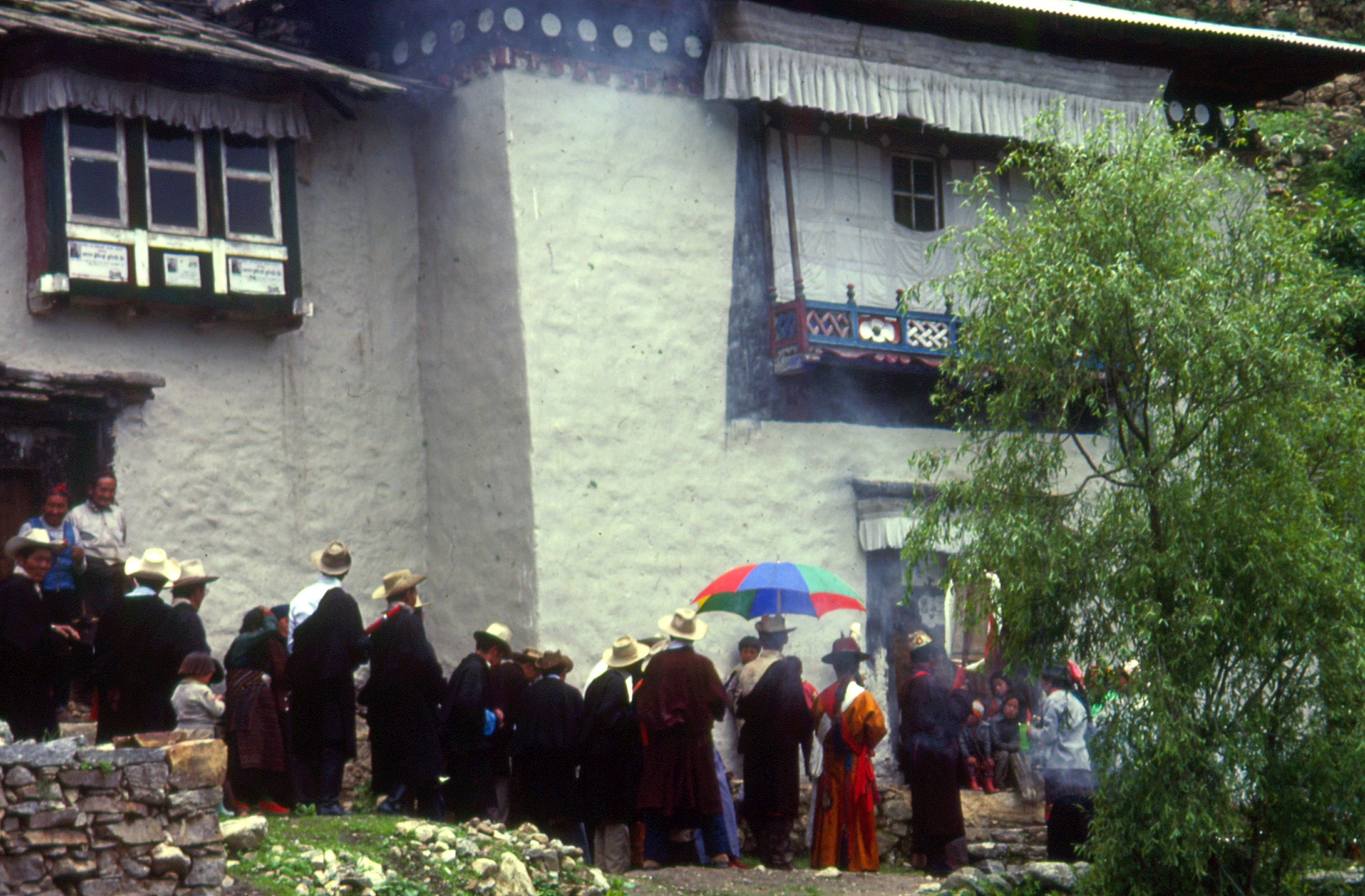
The men of the village gather for prayers to Khumbila start the festival. They put up new prayer flags, share chang (rice beer), do traditional Sherpa line dances, and throw tsampa (barley flour) for good luck.
The cowboy hats were adopted as fashionable wear by Tibetans and Sherpas after members of a 1905 British expedition to Tibet wore Stetsons.)
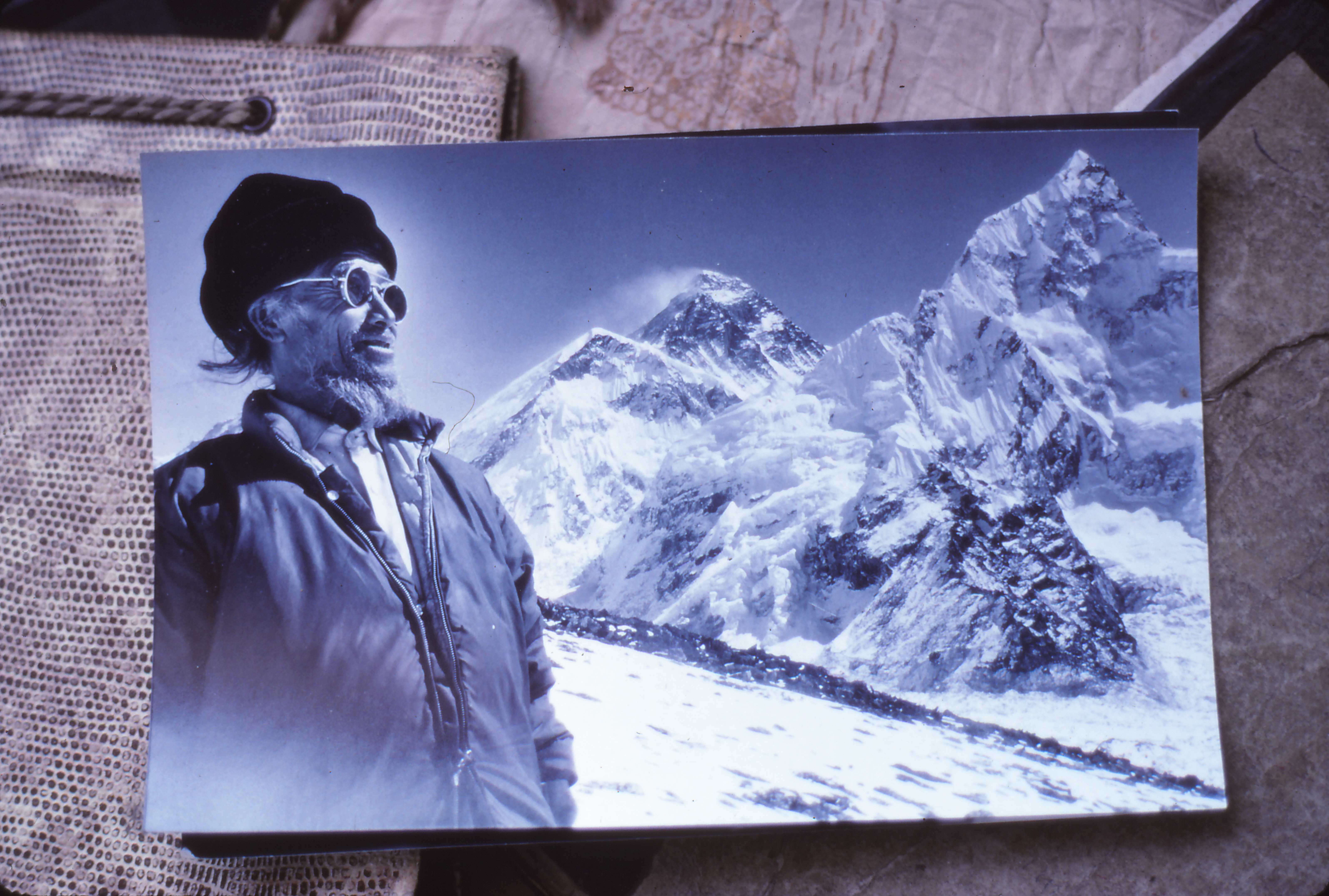
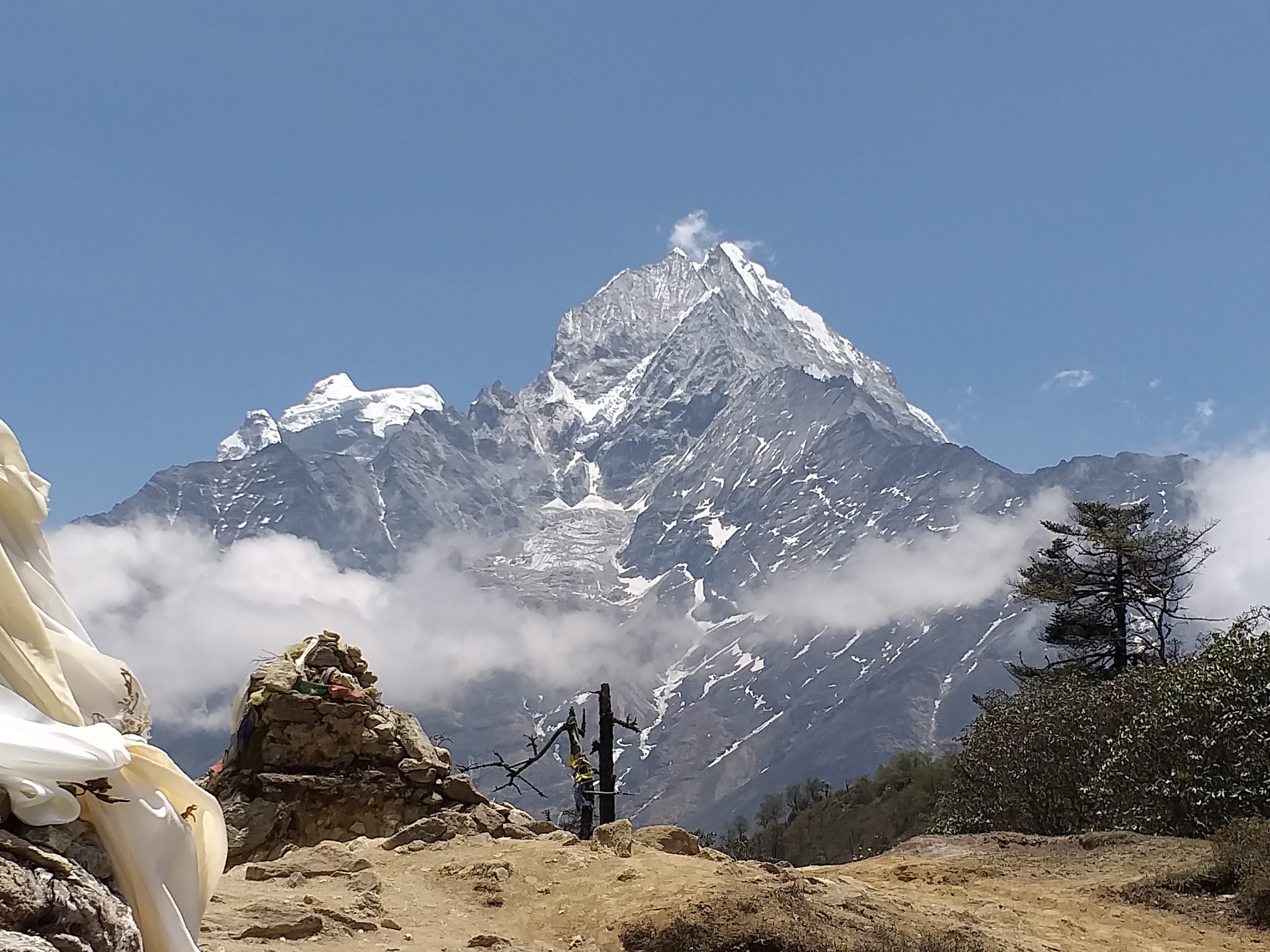
The Khumbu valley, with Jomolungma (Everest), Khunde and Khumjung villages, and Ama Dablam
“This valley is sacred to us Sherpa,” says Tengboche Rinpoche. “The only way to come or leave here is to climb over a very high pass or to trudge up the steep gorge of the Dudh Kosi river. We live in a protected place.”
Rinpoche then recites Sherpa narratives describing how special spiritual powers were used twice to create a beyul, a sacred sanctuary, in the Khumbu valley — first to sanctify it and then to open it as a sanctuary.
“One of our religious texts foretold that in the future … the religious people would have to run away to secluded mountain valleys described in religious texts.”
When helping to establish Buddhism in Tibet, Guru Rinpoche (founder of Himalayan-Tibetan Budddhism) predicted that there would be times of trouble when some people in the Tibetan region would have to flee their homes. He also sanctified and hid many valleys in the Himalaya to serve as sanctuaries.
Guru Rinpoche instructed some of his pupils to write guidebooks which hid in the rocks and earth. These hidden teachings would offer directions on how to get to the sanctuaries. In times of trouble, various inspired lamas and their devout followers would be able to find these places by following the directions in the books.
Guru Rinpoche painting on a cliff face.
The Khumbu valley is one of these hidden sacred sanctuaries, these beyuls.
“When there were troubles hundreds of years ago, we know that the ancestors of the present-day Sherpas left Kham in far eastern Tibet because it was against their religious belief to fight. They moved westward along the north side of the Himalaya.
“They were looking for a beyul, a sanctuary, because the lamas leading them were follow- ing the directions recorded in a religious text. The lamas needed not only the skills to read and understand the book, but also the spiritual power to recognize clues in the landscape, in order to discover the beyul.”
The Sherpa ancestors crossed the Himalaya through a pass to the west of Khumbu. They started small homesteads lower down near present-day Lukla. The first Sherpa to enter the beyul, Phachhen, struggled to walk up the wild canyon, clambering up and down around cliffs, boulders, and trees. Eventually, several families settled on the warm slopes below the present villages in the upper valley, the Khumbu beyul.
The first Sherpa to enter Khumbu walked up the rugged canyon.
“When Phachhen, the first Sherpa, arrived in Khumbu around five or six hundred years ago, the valley was covered by snow and the glaciers were much bigger than they are now. Gradually the snow and ice melted.”
Khumbu is not the first or last beyul to serve as a sanctuary in the Himalaya. Others have been located across the high Himalaya of Nepal, Tibet, China, India, Bhutan, and Pakistan. To the southeast of Khumbu, the beyul of Khenpalung has yet to be opened for the devout.
I ask Rinpoche about an American scholar who organized an expedition that succeeded in crossing several high passes to enter Khenpalung. Rinpoche responds:
“He found the way into Khenpalung, the physical place, but did not see the real inside place. Our friend was not the right person, it was not the right time, and the team did not have the spiritual preparation to see all that was there. For a beyul to be revealed, the directions to find it must be followed by the right group of people with strong faith and pure motives.
“So it is with the beyul: we see and hear part of what is there, but we miss certain things be- cause we aren’t ready or able to perceive them. The inside of the mandala was invisible to them.”
I wonder how to interpret Rinpoche’s remarks. Perhaps being spiritually unprepared is like being tone-deaf; certain notes just do not register. The fact that the Khenpalung beyul has been physically entered but not spiritually found suggests that it is not a place where we must go on foot.
Is a true beyul a place that we find in our minds? We need spiritual power, like Phachhen, to thwart the demons of greed, ignorance, and desire that will obstruct our path. But the path is there. It takes only determination and courage to follow it.
The beyul is an inside place, a spiritual sanctuary. “The most important beyul is in our minds,” says Rinpoche.
Sherpas use the high mountainsides of the beyul as pastures.
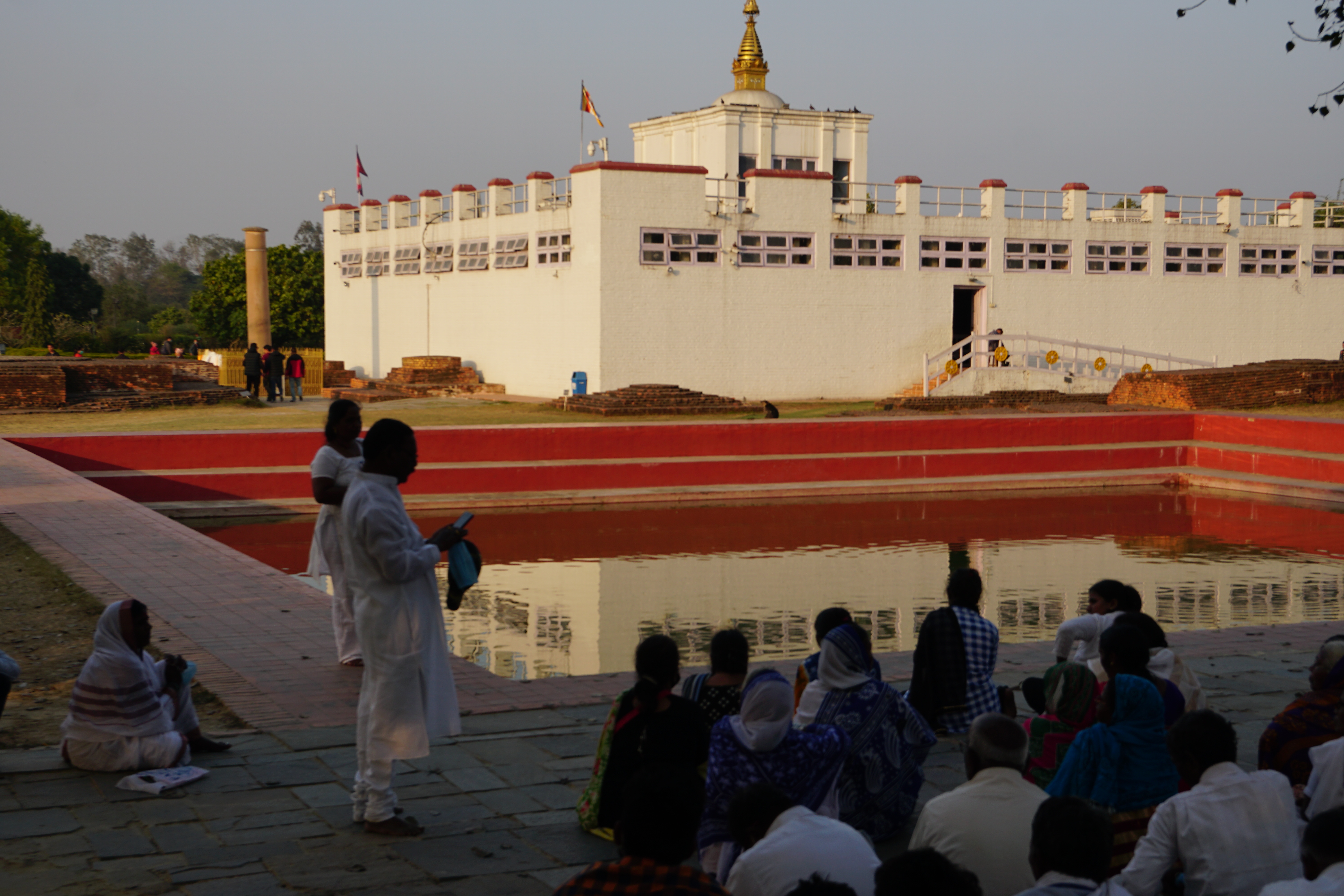
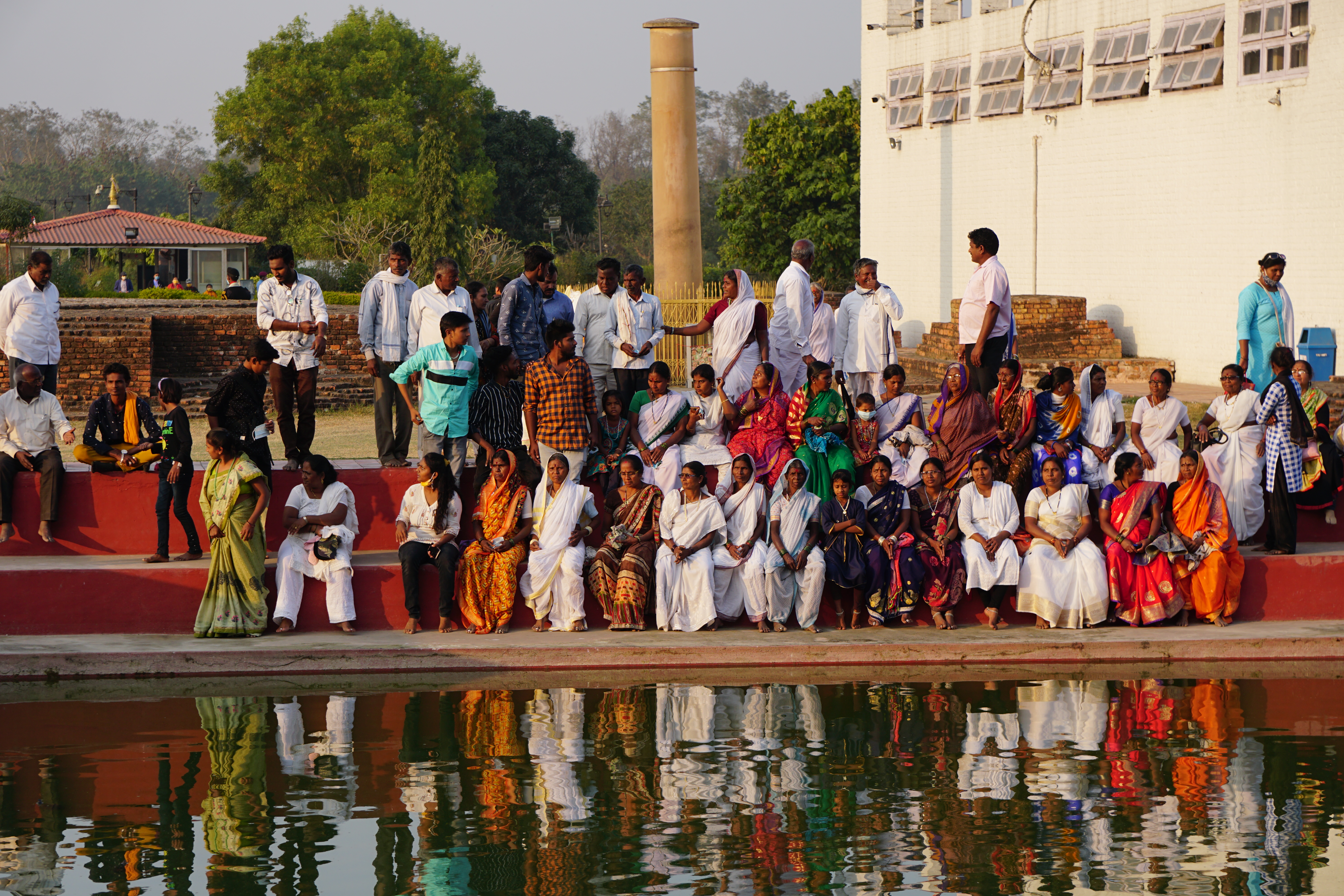
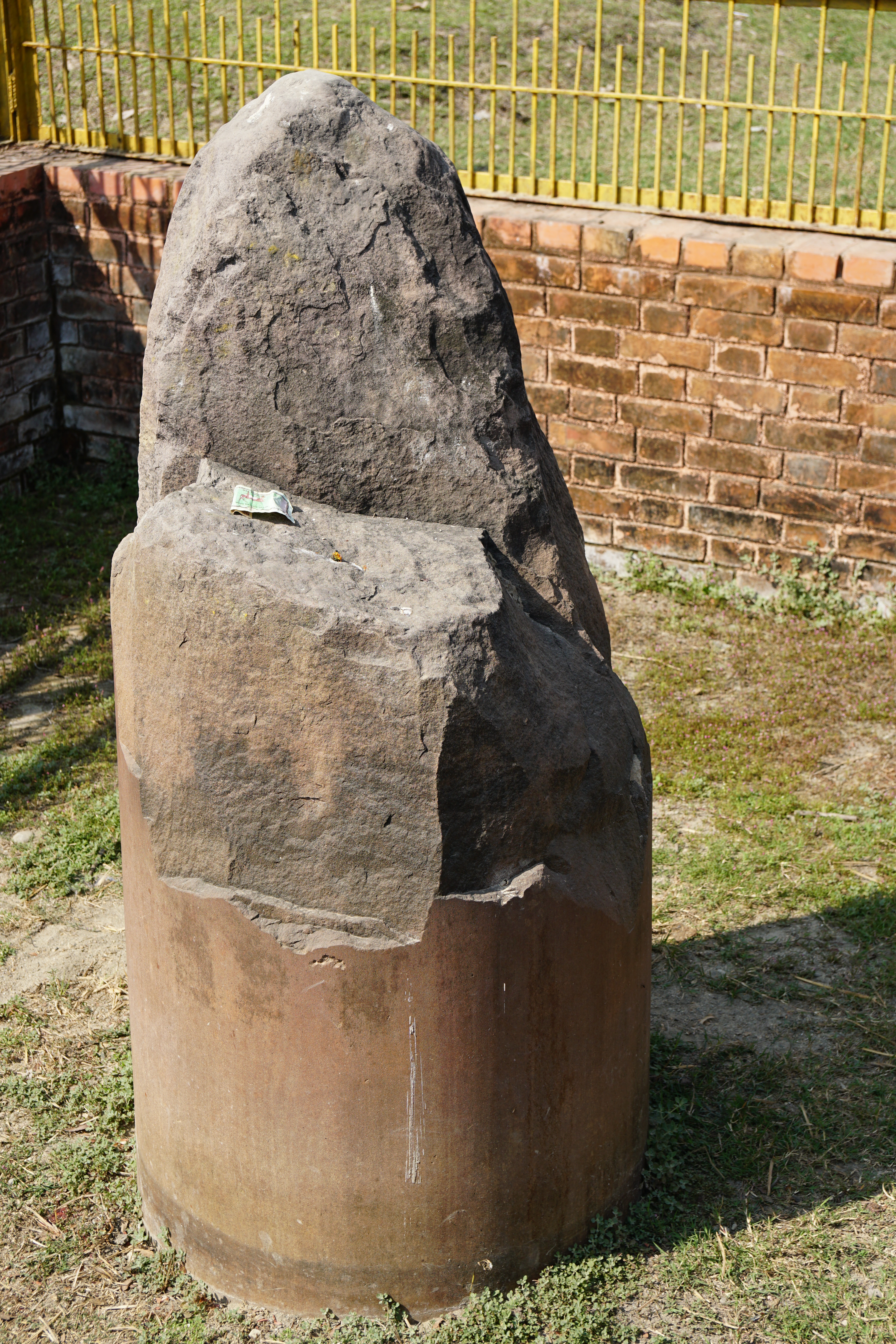
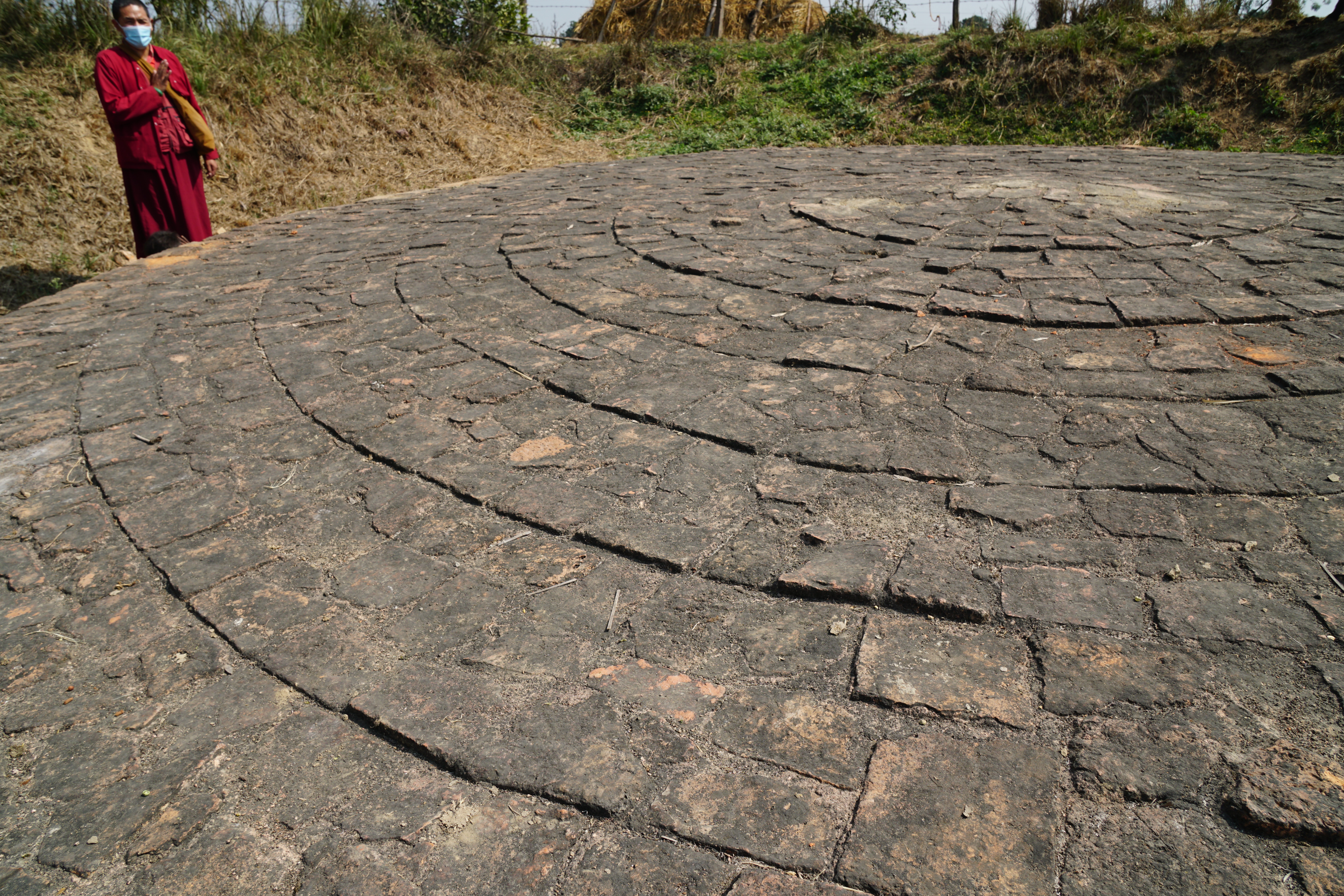
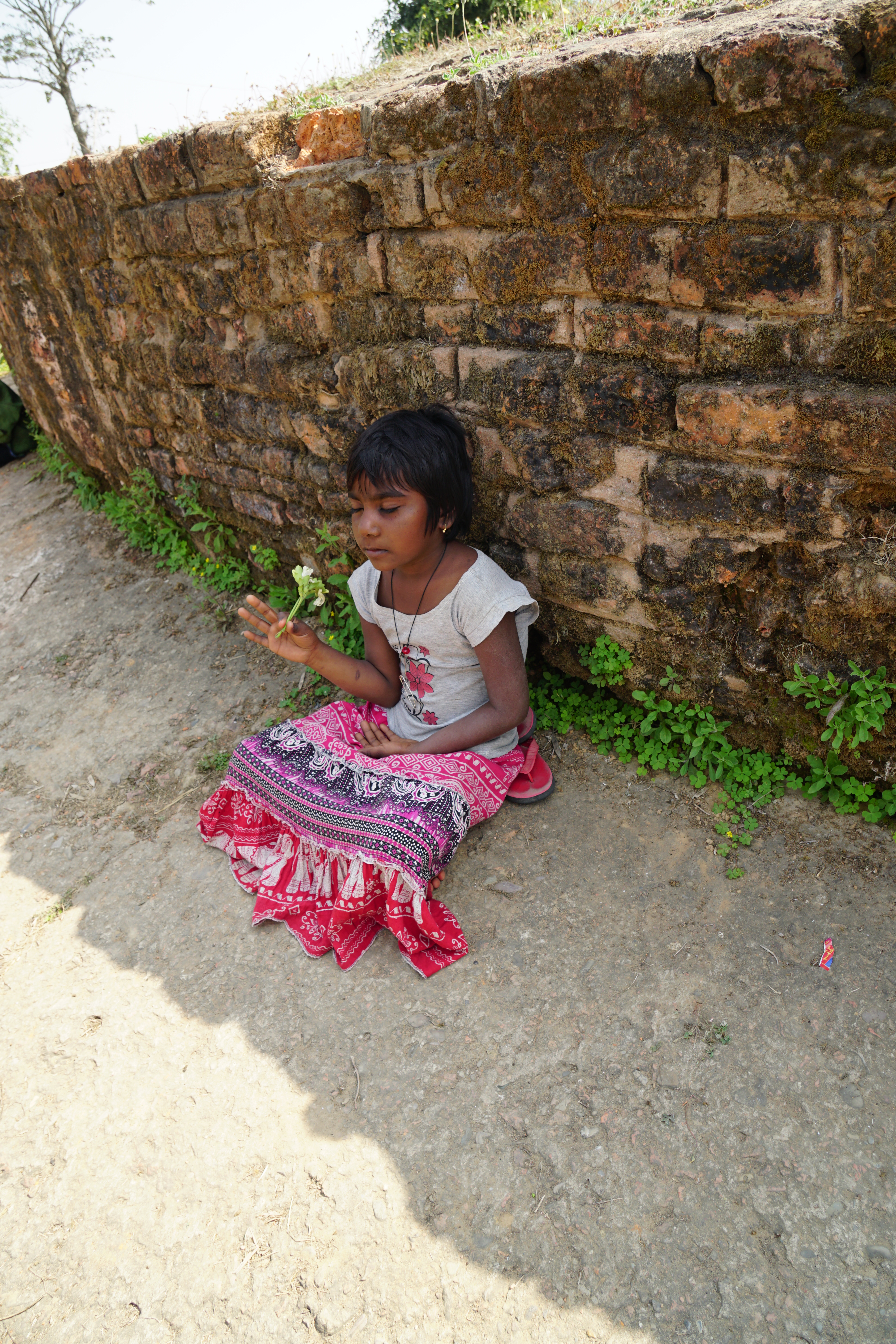
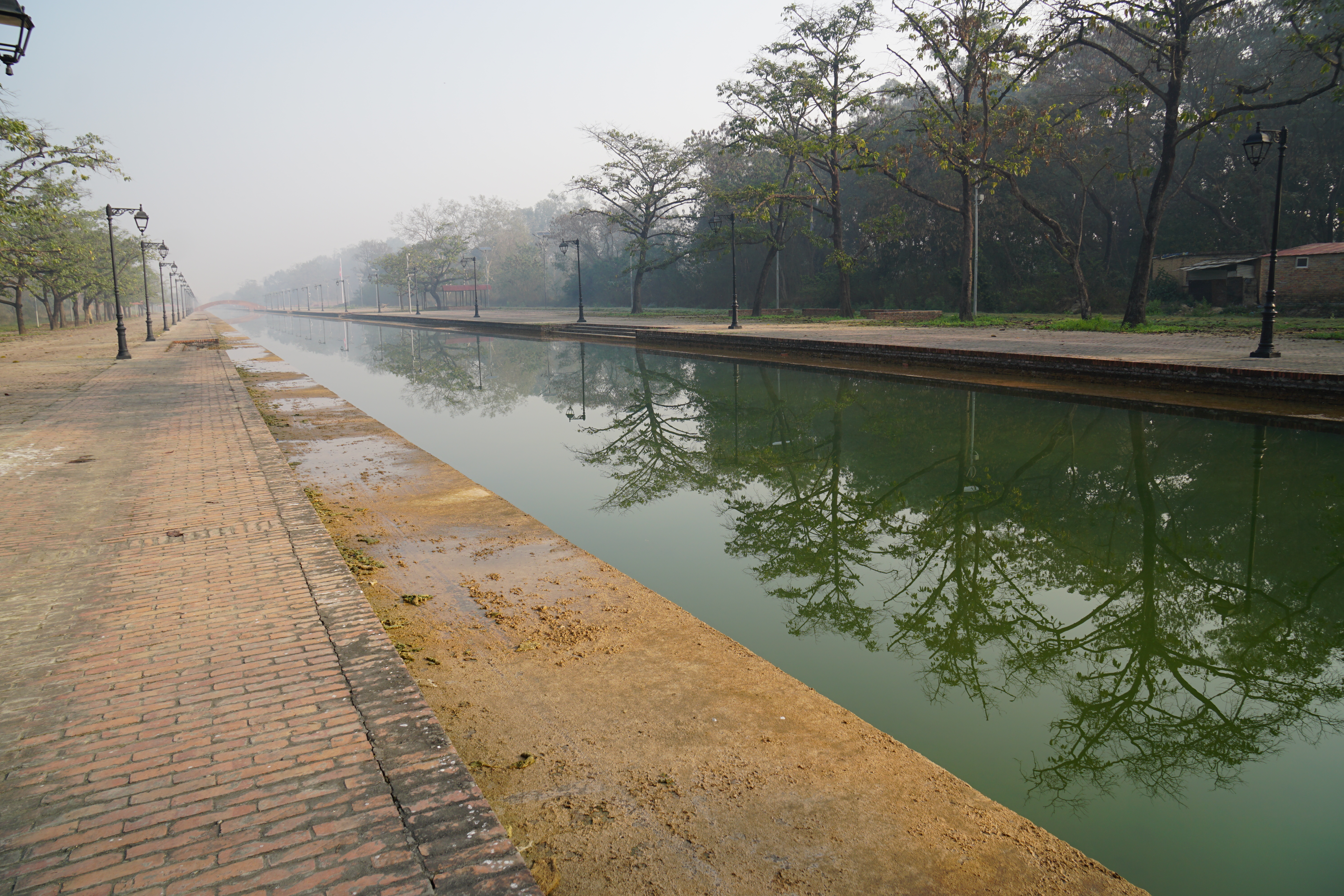
To think that in a rundown area of mud huts and struggling farmers there was once an empire of wealthy kings, for millennia, the first three Buddhas and then the historical Buddha of 2500 years ago were born near here.
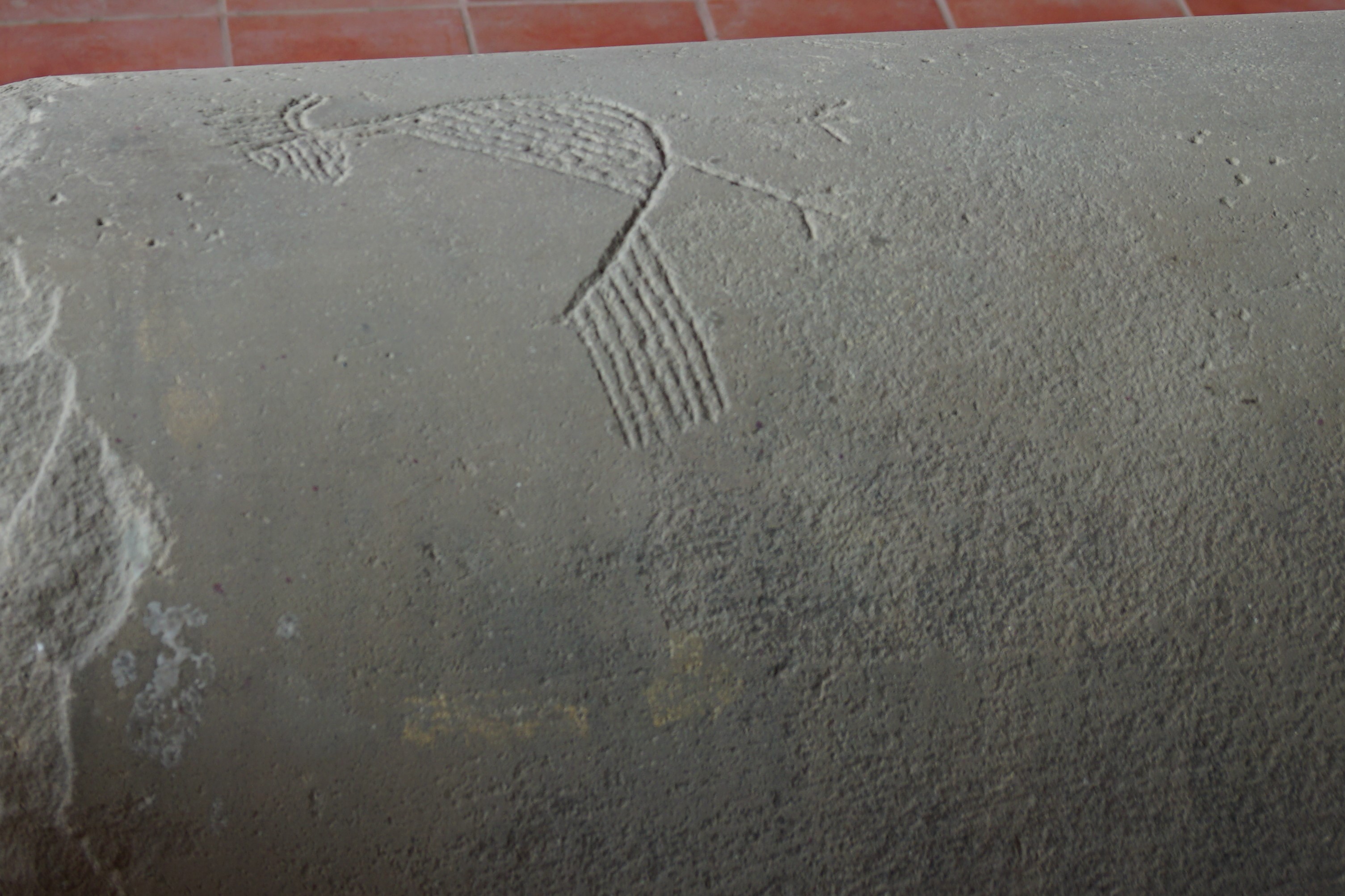
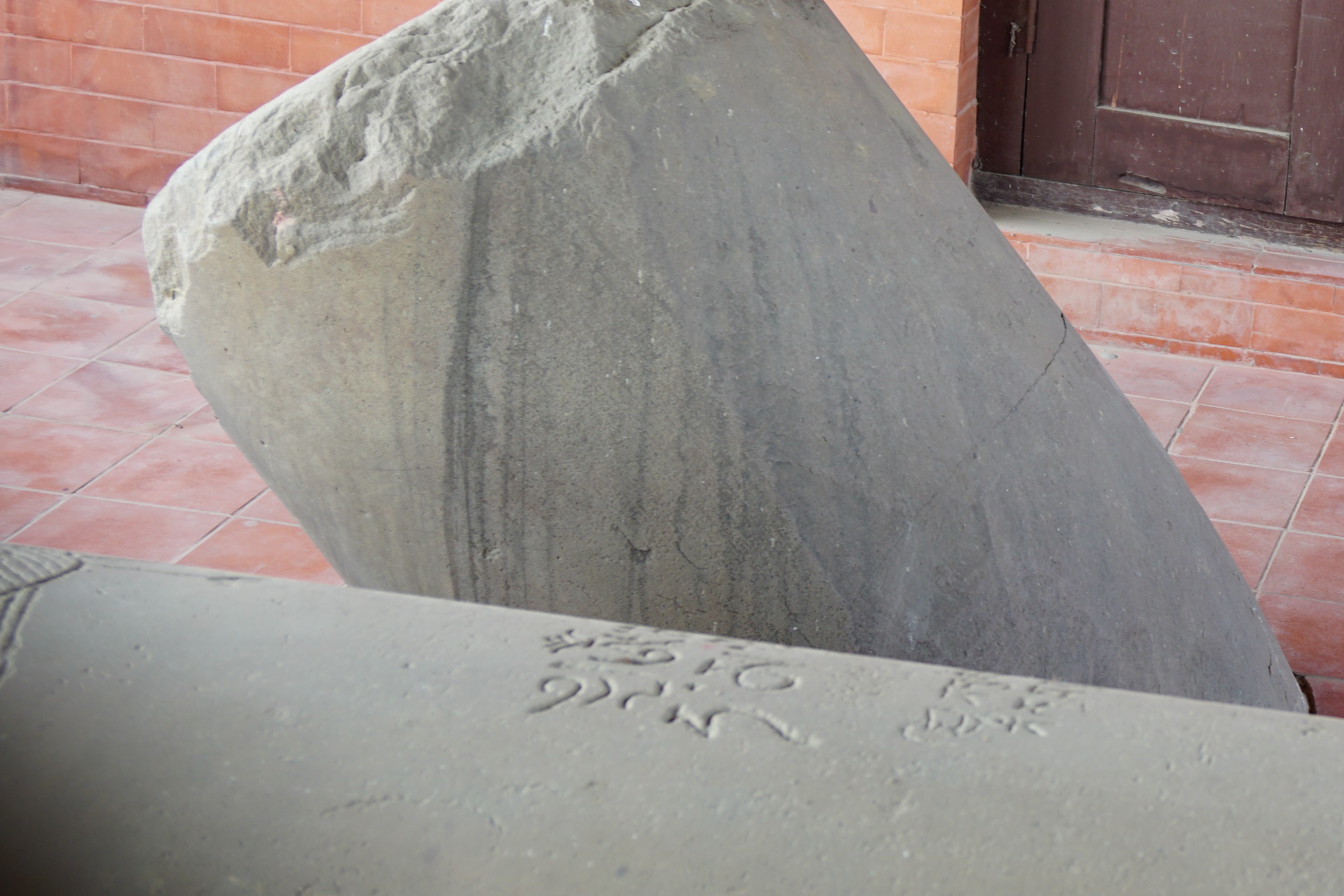
These were civilizations that could mill a massive stone pillar to such a smooth even surface. These pillars commemorate the births of ordinary humans who came to live in an enlightened state to inspire others. Here were born individuals whose teachings could change the world, here in these districts of rundown roads, houses, and families in mud huts.
Here was a time and a place and a young man who turned his back on the princely comfort of his life to find a way to seek a more universal truth. That we will all go old if we are lucky, we all will suffer and we all will die.
In the Kapilvastu ruins is the west gate from where he departed the palace and princely comfort. Now it is ruins of walls in the dust. A big tree and then acres of ruins. I wonder what conditions the ordinary people lived in.
Were they in mud huts or brick houses? What was the society where he lived and the way of life for the ordinary person?
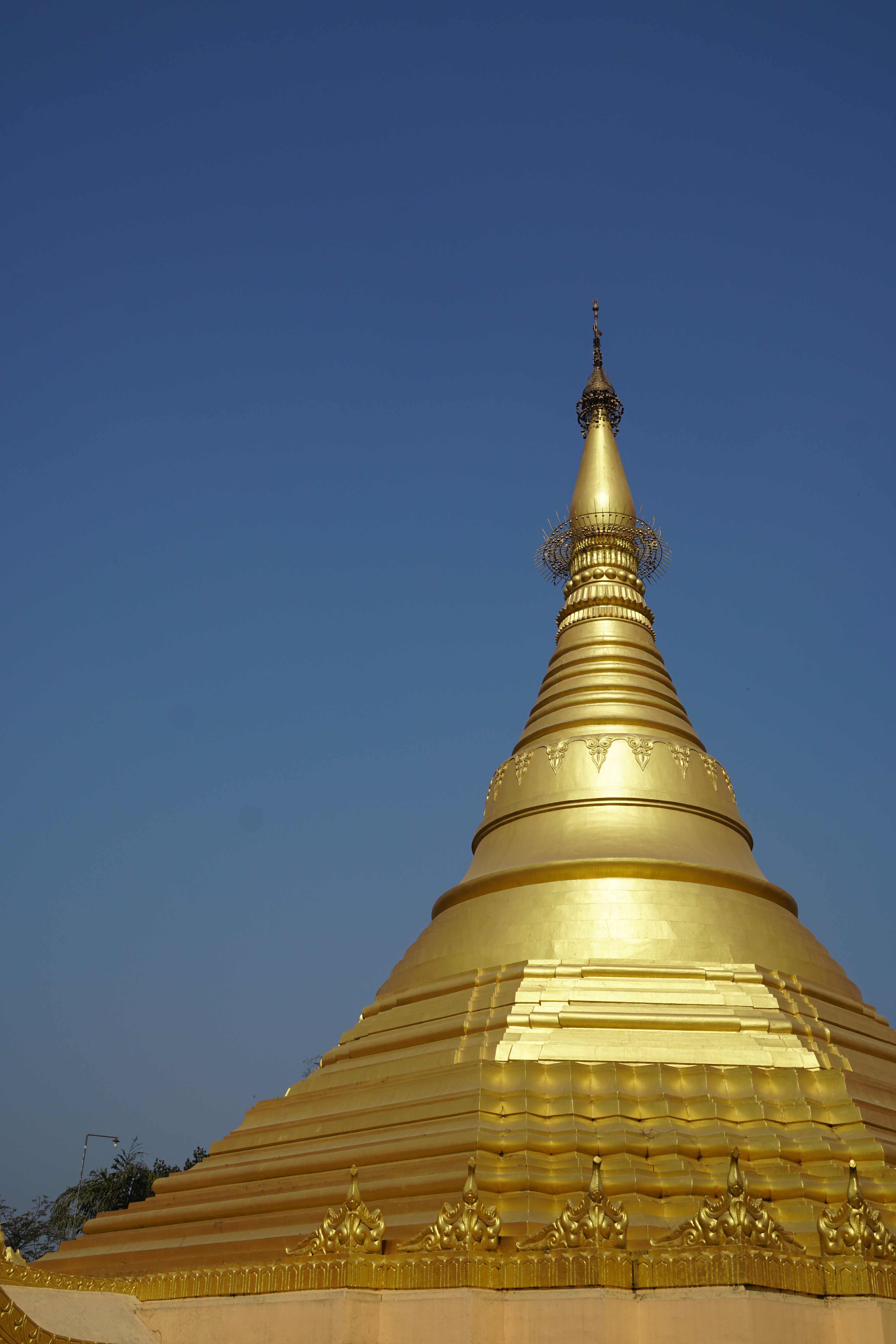
Lumbini is now a place so sacred to Buddhists from so many countries that have built temples here.
Copyright on all photographs (c)Frances Klatzel 2022
This letter on my desk sits shining with the embossed gold lettering and logo of the State Counsellor of Myanmar. Complete in gold embossed folder and envelope. Delivered with great intent by an earnest young embassy official in late January 2021.
Our latest fan mail but no ordinary fan mail… it is from a head of state. A woman so cherished by her countrymen and once by the world, a winner of the Nobel Peace Prize, a woman who stood up to the generals and endured years of solitude in house arrest. Winning two elections, now after the second victory, arrested. Where is Aung San Suu Kyi and how is she?
The signature on the page… did the world expect too much of her. She pursued the dream of democracy but equity for all Burma’s citizens seemed to be beyond her interest and reach.
Ironic how she as a Buddhist could not comprehend the urgency of compassion for all in a crowded world with shifts of people and movements.
The Rohingyas must be part of a people living along that southern coastline, moving, trading, being brought back and forth by the shifts of power and the powerful as they played their games for more power and prestige.
The envelope on the table, thanking me for books on her mentor, Dhammawati Guruma. How excited I would have been to have received the letter when I sent the books with a friend moving to Myanmar four years before. Instead, the little package sat forgotten on a shelf until my friend was packing to leave Myanmar. She was kind to take the time to send the books through her office connections to the head of state. A woman who had lived in Nepal and volunteered at the nunnery to teach the young women English.
How this woman soared into a global role, leaving her husband and two sons, leaving a life of comfort in British academia, to stay in Burma to fight for democracy… for elections. It is such a complicated country, Burma, with layers of ethnicity, discrimination, power, guilt, denial. She had one goal, to bring a voice to her supporters.
Buddhist in name and ‘religion’ but in spirit… we might wonder. Or are they like so many countries where a few wield power, keeping their heads down, watching the track in front of them, not looking at those to the side.
What is democracy if it is not for all? Can we criticise when blacks in the USA or indigenous people in Canada and Australia face discrimination, hardship, and often oppression. The persecution of the Rohingya was an overarching brutal reaction to slings and arrows from the insurgent group.
Wrote my friend: “Myanmar is a complex country with a painful history and not one person even Aung San Su Kyi could resolve the deep fractures of that society and decades of prejudice, we all misunderstood her and thought she could help end of the suffering of the Rohingyas .. still she has tried her way to make progress for her country , it’s just a more difficult journey and she is not as perfect as the West portrayed her .”
Derek Mitchell, former US Ambassador to Myanmar told the BBC: “The story of Aung San Suu Kyi is as much about us as it is about her. She may not have changed. She may have been consistent and we just didn’t know the full complexity of who she is. We have to be mindful that we shouldn’t endow people with some iconic image beyond which is human.”
Sending prayers for safety and well being of Daw Aung San Suu Kyi and all the people of Myanmar (Burma).
Living in Nepal for several years, you sort of get used to the little tremors… you get jolted awake in the middle of the night, or your desk does a quick shake.
My first earthquake was in the monastery kitchen at Tengboche when the tea ladles hanging on the wall began to sway. It was confusing – just a mild sense of motion – but the two Buddhist lamas sat calmly.
The first sense of the 2015 earthquake might have been ten days before when we were planning a work field trip to the mountains in Manang. We knew that the road was bad with ice and snow left over from the winter… but I had this ominous feeling.
I was able to change the field schedule to do a shorter trip first and arrive back in Kathmandu on the Thursday before… but having no idea of what would happen on Saturday. Otherwise, on the originally planned date we would have been driving on a road across several cliffs at the time of the earthquake only 50 kms from the epicentre.
It was a muggy but chilled out late morning waiting for a friend to have coffee.
The main earthquake started as several little quakes that kept building in intensity over five minutes that felt like fifty.
That afternoon as I knelt under a table and the shakes grew and grew, it was as if there was no past and no future. It was as if I was totally in the ‘now, the present moment.’
That moment of being alive but connected to all those experiencing the horrendous destruction and death happening with each shake.
The power of the quakes… 7.9, 6.9, 7.3 brought huge devastation to some districts of central Nepal. Old style houses made of rocks and mortar collapsed killing about 9,000 people.
Over the next 48 hours especially, the ground kept on moving. We later counted on the government seismic website that there had been 108 aftershocks in 48 hours that were over 4 in magnitude, earthquakes in their own right if it had not been for the big one.
The weeks and months that followed were filled with the immediacy of connecting people and places and groups… always in the moment.
The frequent aftershocks drove a very tangible fear of being in the wrong place at the wrong moment.
It was a very moving to see people come together, to see how young people organised to help those in need. Helped me to sense our common humanity and the importance of helping others. A very tangible response to the tangible fear.
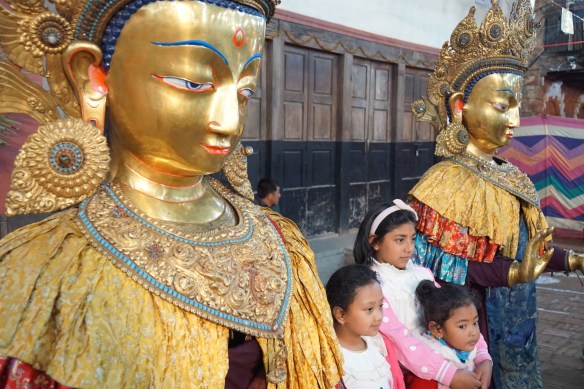
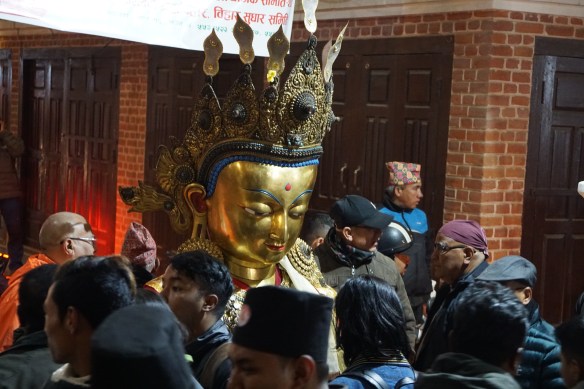
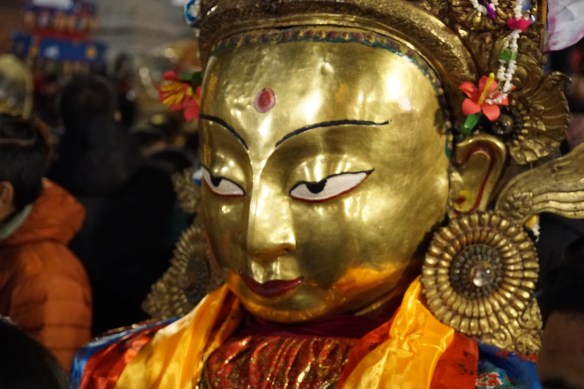
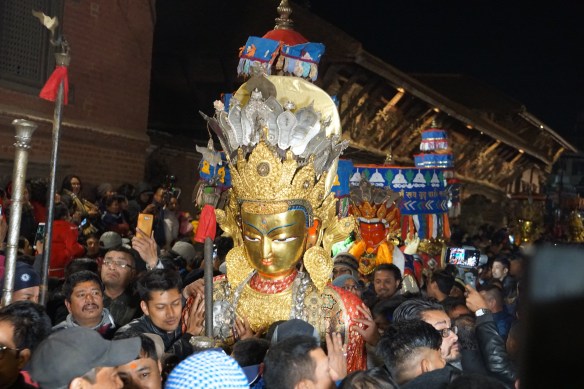
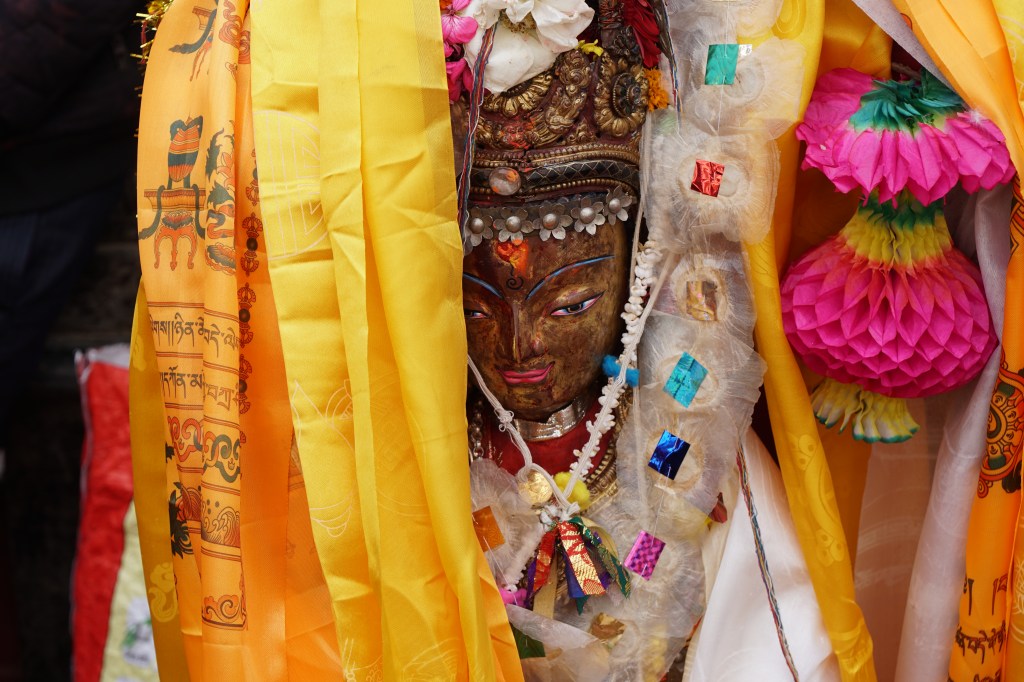
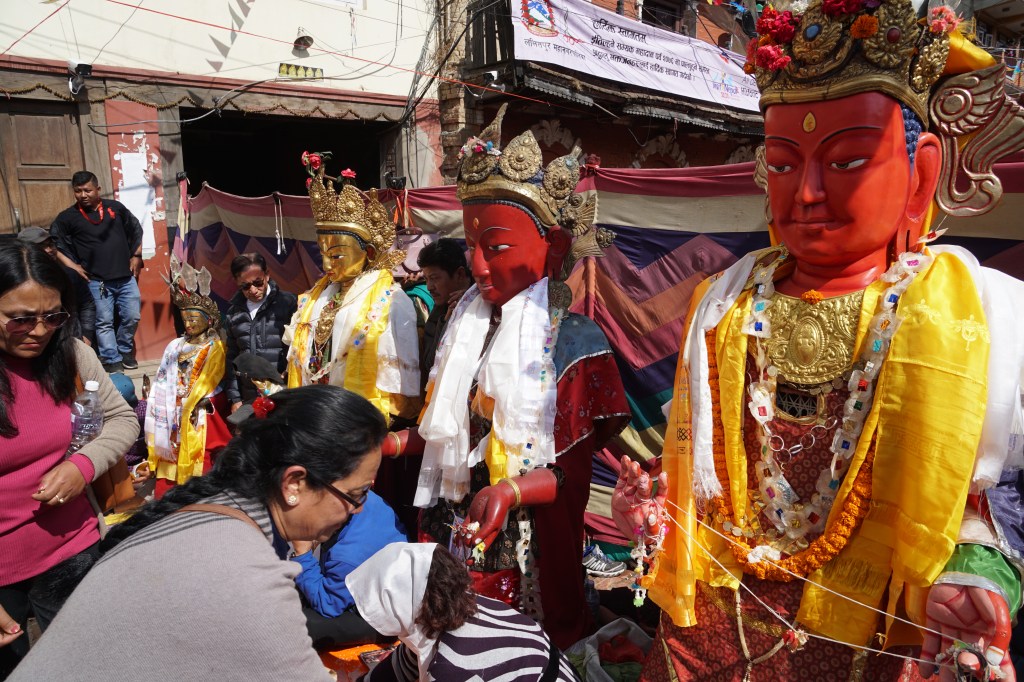
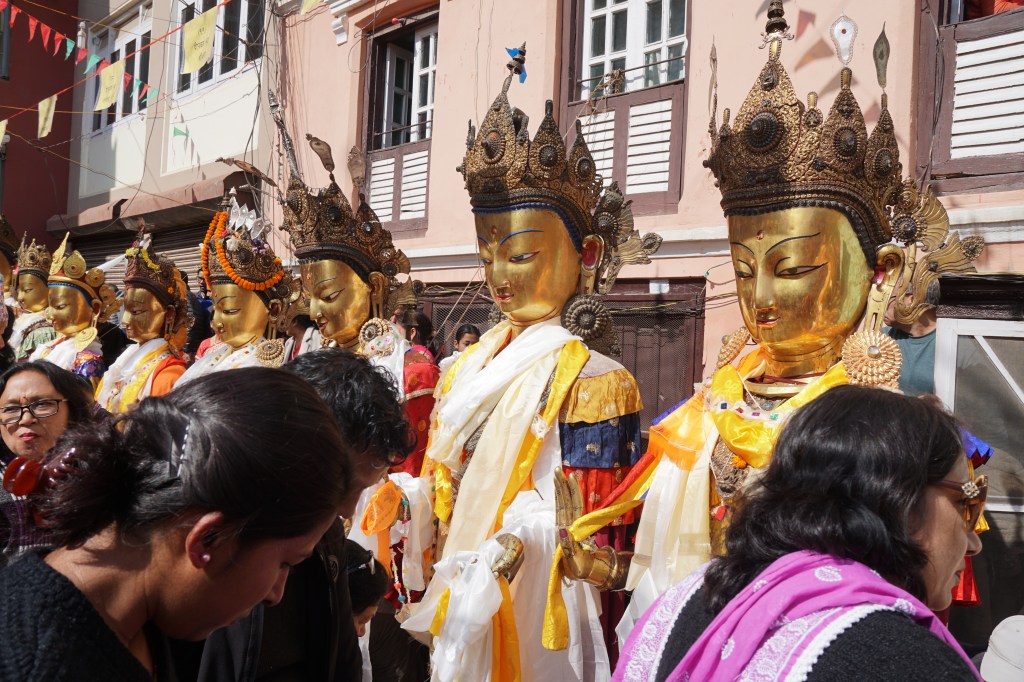
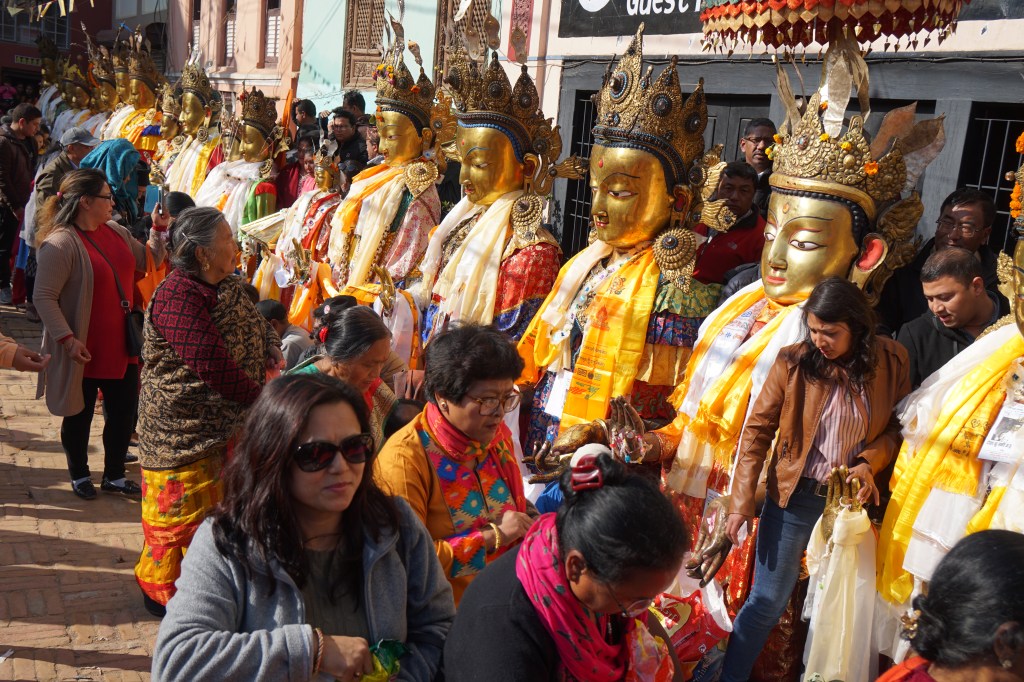
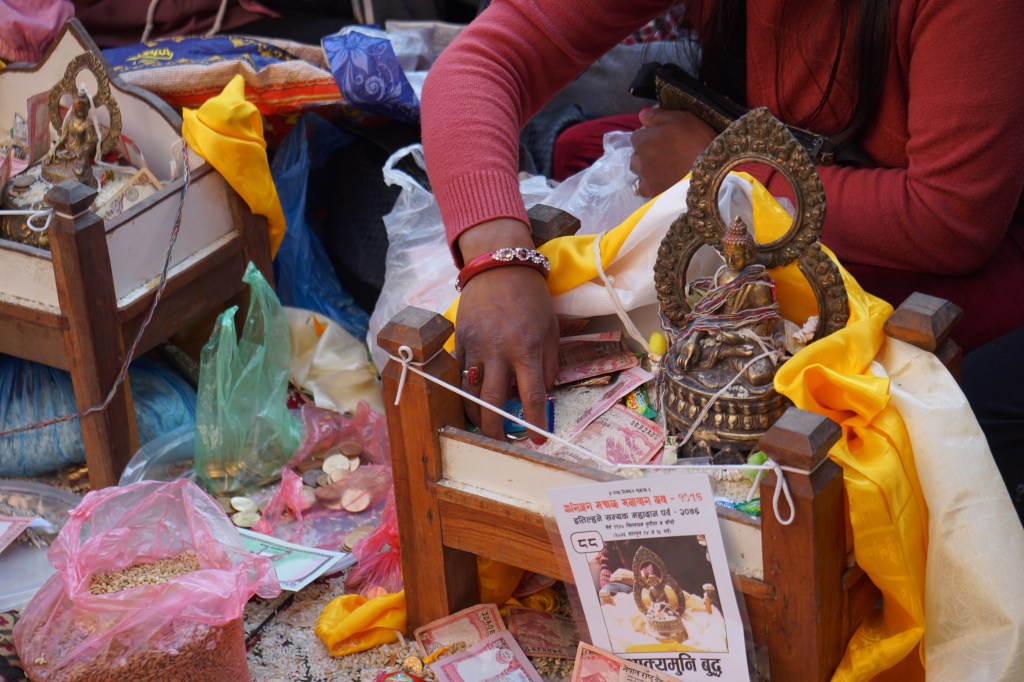
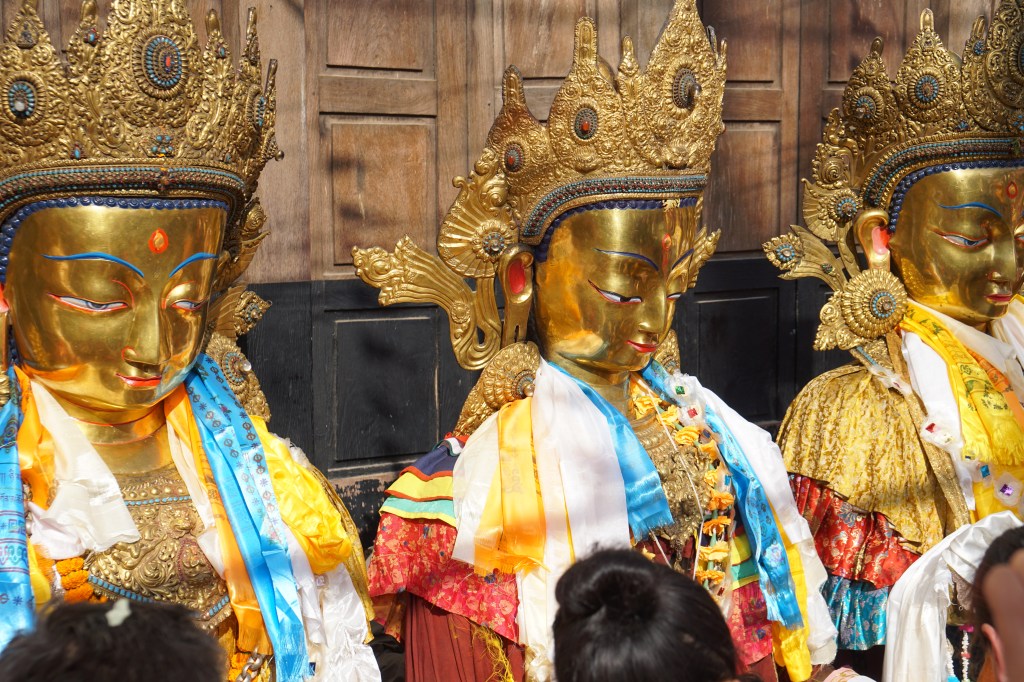
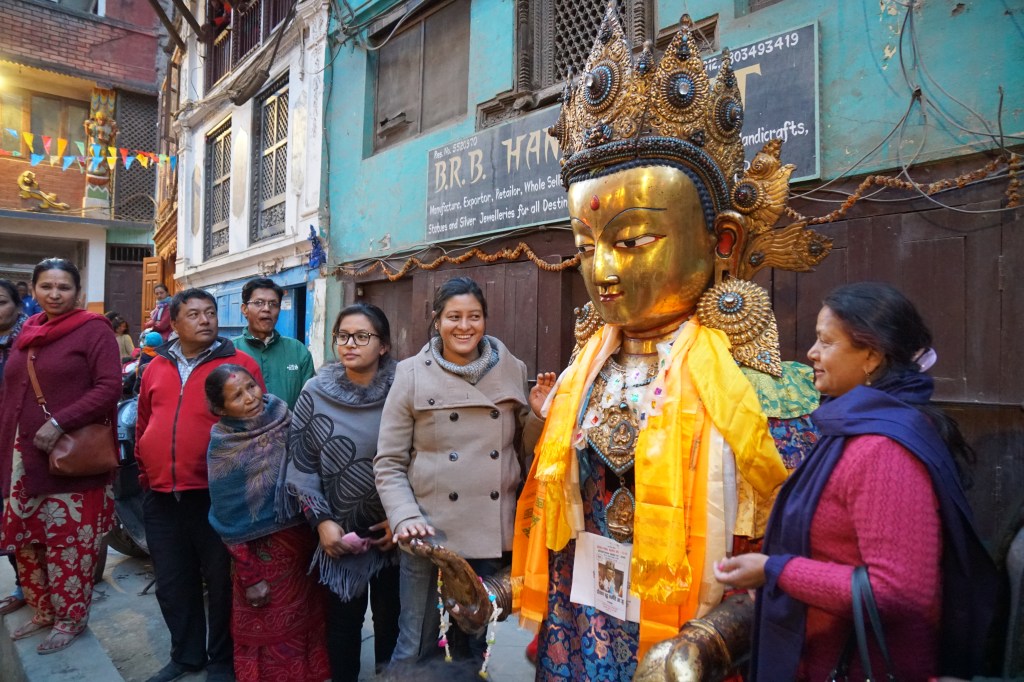
Again after four years, it is time for the Samayak when all the households with special Buddhist statues in Patan bring them to the big squares in the middle of the old city. The last Samayak was in 2016, just months after the earthquake. A couple of the temples damaged then have since been rebuilt.
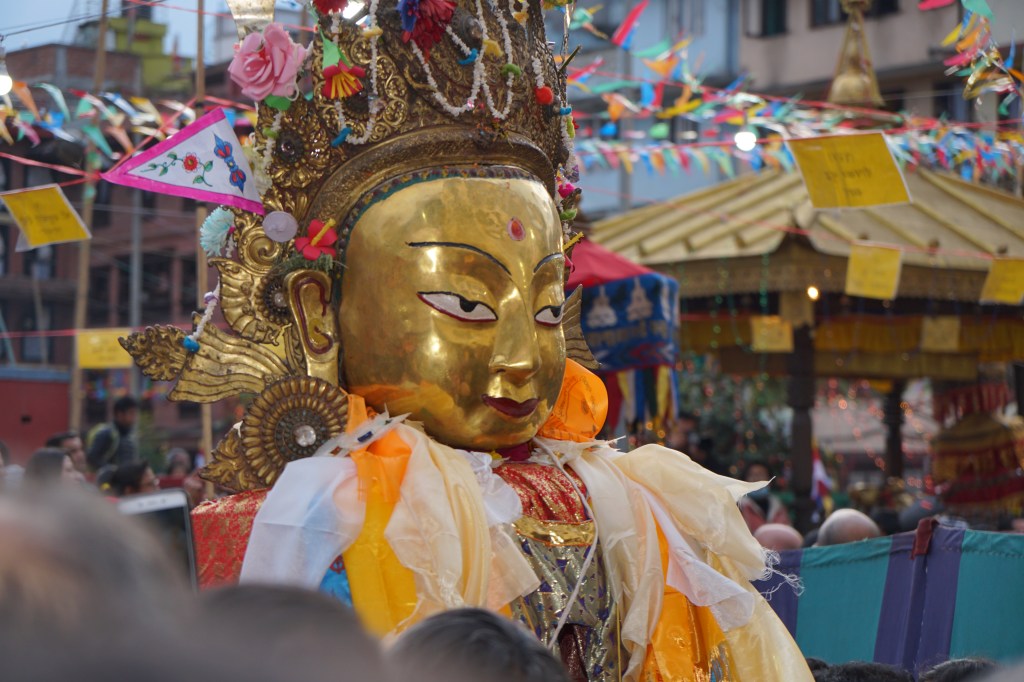
First each household brings their ‘deity’ out to the front of their home on the street, where they offer prayers for the journey and gathering. The statues might be any size from six inches tall to huge heads over four feet tall that are worn by a man carrying them. Needless to say, many other family members help guide him on the journey through the streets.
Then, the Buddhas assemble in Patan Durbar Square before moving over to the Nag Bahal Square where tens of thousands of people come the next day to offer their prayers and devotion. The queues to enter the the courtyard stretch for blocks along the nearby road.
Come twilight on the second day, after a procession by the elders of the community, the Buddhas head home with crowds lining the lanes and reaching out to touch the statues as they pass. After a brief rest outside the home or temple, the statues are returned to their secluded homes. Portions of the offerings are shared with community members sitting and waiting in rows
Standing in the middle of the sandy trail with the wind howling, the sun blazing, no shade and not a tree or shrub in sight.
“From right here, 700 years ago, the Lo kings cut trees for the gompas in Lo,” says Chimi, our guide.
The only trees we’ve seen in four days of walking are those planted near irrigated fields in villages, oases of green in this rocky, barren, desolate landscape. Eroded bones of the earth. Canyons out through the layers of rocks lay down over the millennia as sediments on the floor of an ancient sea. Rocks in reds, rocks of beige, a few striped rocks with green argallite. Rocks, sand, canyons, and sky.
“For those huge pillars? ”
“Yeah, this all used to be a forest of big trees. It’s in Khampo Tashi’s book.”
Those pillars, those huge pillars at least 3-4 feet in diameter and 25ft high are so magnificent. Many came from a single piece of wood … That would have come from this desolate place. Huge timbers that must have been cut from even larger trees.
Larger trees that grew until 700 years ago in this now barren high desert.
A forest where it is now high altitude desert. What happened?
Mustang is an old place for the Nepal Himalaya. People have perhaps lived here for 6,000 years – at first in caves cut into the sandstone cliffs. Gradually, Lo became the walled capital of the Lo kings.
A walked city like none other in the Himalaya. More and more building with growing affluence from the salt trade, more gompas and monasteries. At the pinnacle of the Lo dynasty and culture, three huge gompas were built of stone, rammed earth and wooden windows, doors, and pillars. Huge pillars to hold the heavy building. And they came from a forested valley that is now this desert place.
The speed of the change both intrigues and depresses me. I no longer find Mustang a fascinating desert landscape but a denuded land.
A traumatized land where demons and saviours (Guru Rinpoche) fought over bringing Buddhism to Tibet and the Himalaya. Where the slain demons blood is believed to colour the red rocks of the region.
Later talking to the forestry professor stranded in Jomsom, I learn that when trees are cut, their roots no longer have the capacity to hold up the water table so the water drops deeper. Only those trees and shrubs close to irrigation canals or streams can survive.















































 franceslk