Gaiety of Spirit: The Sherpa People of the Khumbu, Nepal

The Sherpa People

A rich culture at the edge of the inhabitable

Most everyone has heard of the Sherpas through the literature of mountaineering.  This awesome reputation however, focuses on a single vocation rather than on the Sherpas’ rich cultural heritage.
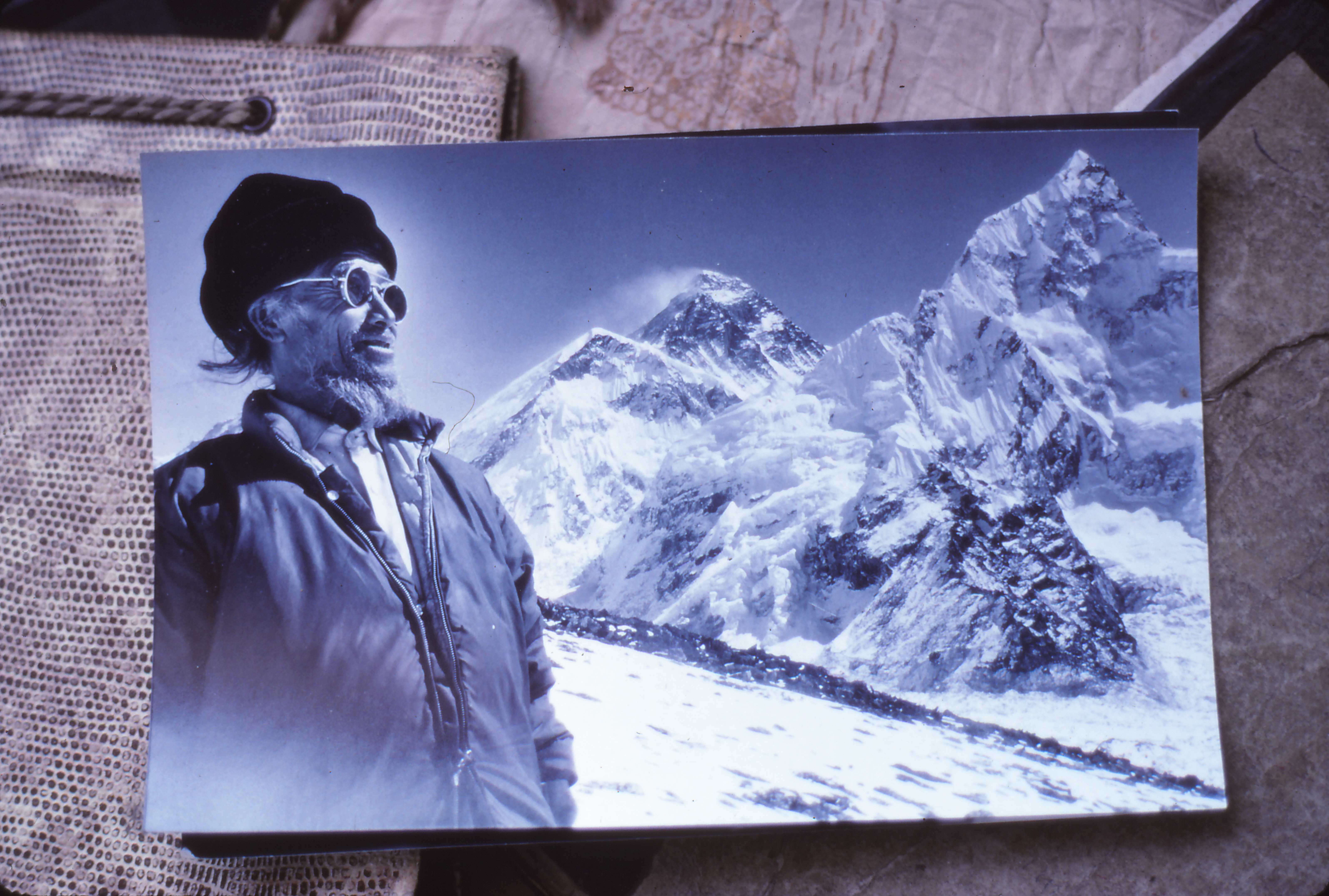
The Sherpas originated as several families who migrated from eastern Tibet and settled uninhabited valleys in the Himalaya about 400 years ago.  Their name “Sher-pa” reflects those origins: “east-people”.  This small group of families brought with them the rich traditions, religion and literature of Tibetan Buddhism.

The Sherpas built their houses on any landform flat enough for agriculture, such as the ancient hanging terrace of Phortse, the glacial trough of Khunde and Khumjung, and the bowl-like valley of Namche.  Their villages face south for more favorable growing conditions, and lie between 7,000 and 15,000 feet above sea level.  Most Sherpas have a home in one of the main villages of Khumjung, Khunde, Thamechok, Namche, Pangboche, and Phortse, but often stay seasonally in huts at the high pastures.

Hard Livelihoods

Here, the cold climate allows the Sherpas to cultivate only one harvest a year from their rock-strewn fields.  To survive in this formidable environment, the Sherpas have always engaged in another livelihood whether trading across the Himalaya or migrating in search of employment.

For much of the late 1800s and early 1900s, Sherpas migrated in search of employment to British-ruled Darjeeling.  Sherpa men first worked as high altitude porters on British attempts to scale the great peaks of Sikkim in 1907, and have worked on every major Himalayan mountaineering expedition since then.  Mountaineers praised the Sherpas’ friendliness, loyalty and dependability.  Eric Shipton was a British “explorer” of the Himalaya in the 1930s-1950s.  He described the Sherpas:

“It is the temperament and character of the Sherpas that have justified their renown and won them such a large place in the hearts of the Western travelers and explorers who have known them. Their most enduring characteristic is their extraordinary gaiety of spirit.  More than any other people I know they have the gift of laughter.”

Sherpa Village Life

Surviving in these mountain settlements requires community effort

Community norms and rules traditionally regulated everything from the collection of fuel wood and leaf-litter, to the movement of the yak herds, to the performance of cultural rituals and festivals.  Members of the community are still elected to three positions that manage agriculture and grazing, forest use, and cultural life.  They have the authority to impose fines on villagers who break the traditional rules, called the “dhi.”

Sherpas raise yaks and grow potatoes as their staple products

In the valleys of Khumbu, the summer monsoon lasts from June to September.  During this quiet but productive season people carry out their chores of herding and farming.  Farming is not easy on these mountains, but all, including businessmen, own plots of land on which they grow potatoes, buckwheat or barley to feed their families.

Most fields for cultivating food crops are at relatively lower elevations of about 3300 meters near the main Sherpa villages.  During the cool winter, herds of yaks are grazed on nearby hillsides; when the summer comes, the yaks are taken up to high valleys where the rains have changed the dry mountainsides to rich, green pastures.

Sherpa families use these valleys as summer pastures for their yak (male) and nak (female) herds.  Pheriche, Dingboche, Lobuche, and Gokyo were established as their summer huts and hay fields.  The shaggy bovines provide dairy products, wool, and transportation.  Sherpas call the male crossbreeds dzopchioks; they are sterile and are used as pack animals, especially on trips down to the warmer elevations that the high-altitude yaks can’t tolerate.  Female crosses are called dzooms.  They produce milk that is almost as rich as a nak’s, and in greater amounts.

Changes in Sherpa Livelihoods

From Trading across the Himalaya to Global Tourism

As a people, the Sherpas have historically responded and adapted to changes brought by the outside world.  In the mid-1800s, the Nepali government granted the Sherpas a trade monopoly by prohibiting anyone but a Khumbu Sherpa from crossing the Nangpa La, the 19,000 ft pass into Tibet.  Many Sherpa families benefited to some degree from the bartering that took place in either Tibet or the border towns of India.

Namche was been the main trading centre since 1905.  Prior to that, it was simply a place where traders from Khumjung stored their trading goods between the seasons when they could cross the pass to Tibet and when they could travel to the lowlands.  The trade to Tibet was drastically reduced after it was taken over by the People’s Republic of China in the late 1950s.

At present a few Tibetan and Sherpa traders cross the pass in both directions.  They can be seen at the weekly market along with lowland Nepali traders.  The weekly market is not a Sherpa tradition; it was started in the mid-1960s by an army officer stationed in Namche to meet the needs of the growing population of Nepali civil servants.

The Sacred Valley

For centuries, the Khumbu Valley has been a sanctuary

To the first Sherpas, the Khumbu Valley was unique and special as a “beyul”, a sacred valley that was set aside by Guru Rinpoche, the founder of Buddhism, to be a refuge in times of trouble.

When the Sherpas came here about 400 years ago, they were escaping political changes in eastern Tibet.  They may also have been migrating at a time of climate change.  The Abbot of Tengboche monastery tells of the Sherpas coming at a time when “the glaciers were much bigger, and Khumbu was covered with snow.

Hence, their first settlements were down near Lukla.  As the snow and ice gradually melted, people gradually founded villages at Khumjung and Pangboche.”

At that time, the rivers had no bridges, the cliffs had no steps; there were no footpaths, no dwellings, no fields of grain, no woven cloth, no cows to milk.  These first settlers transformed the landscape into agricultural fields and pastures for cattle.

However, people may have been visiting the valley well before the arrival of the Sherpa people.  In fact, oral traditions hint that Rai shepherds may have been using the Khumbu’s high pastures well before the Sherpa, and old ruins in the valley are said to the remains of Rai shepherd’s huts.

Prayer Flags Over Tin Roofs

The Sherpa religion came through the oldest sect of Tibetan Buddhism, the Nyingmapa, which was established about 1,240 years ago.  The Sherpa history and teachings are recorded in Tibetan script and their language is a dialect derived from Buddhist books.  Traditionally, these books were stored in each village’s temple where lay ministers, lamas, would conduct ceremonies and teach religion to the local people.
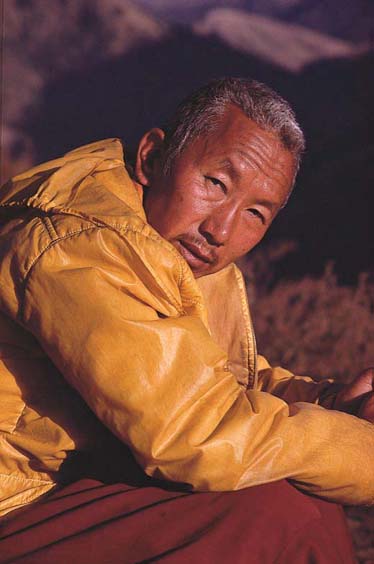
The power of nature is embodied in protective gods.  For example, Jomolungma resides on Mt. Everest.  Qualities such as wisdom and compassion are also visualized as deities to help one concentrate while meditating.  Prayers to them may influence important events and daily activities.  Weddings, funerals and births are accompanied by pujahs of offerings and prayers.

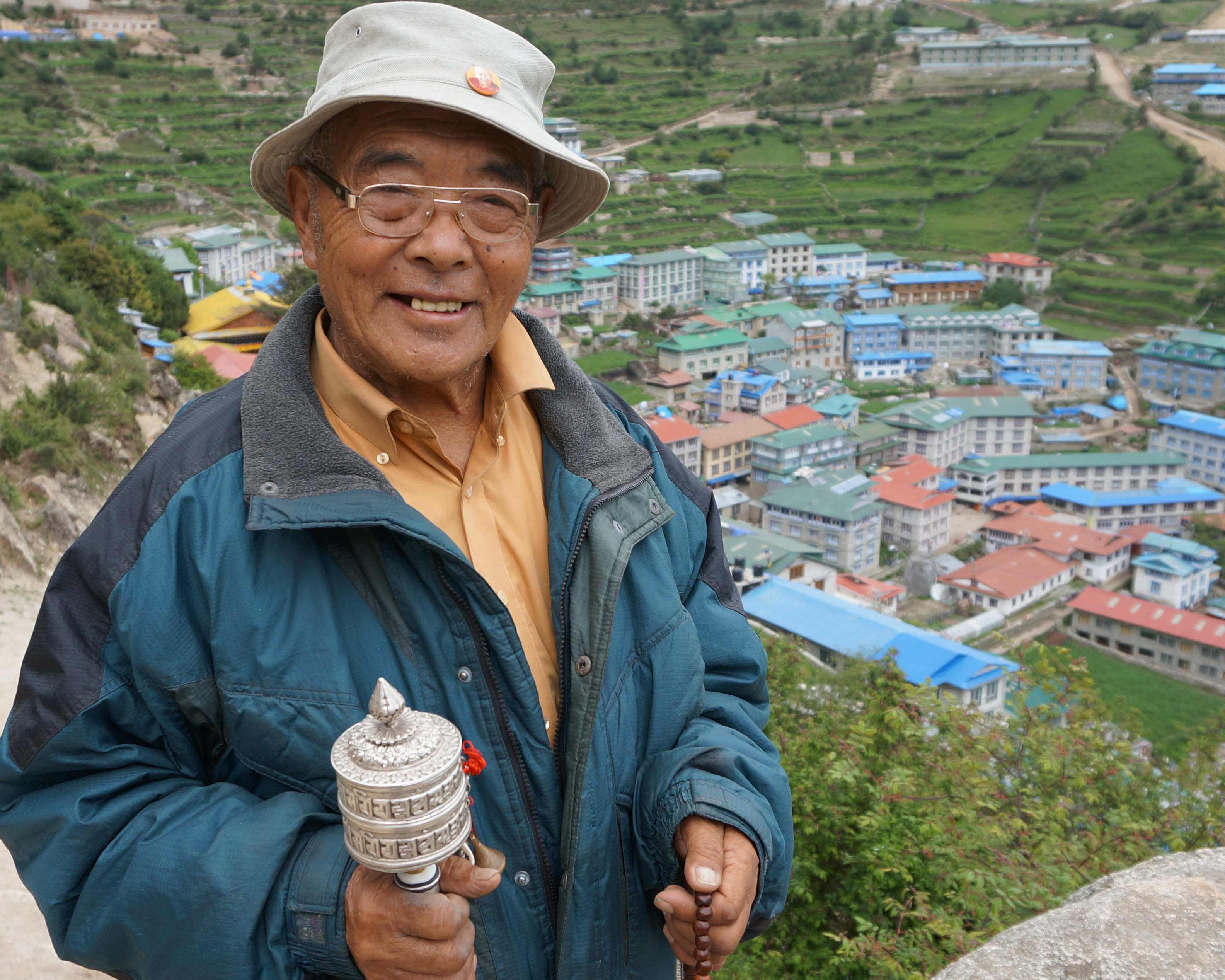
Anyone may build a religious monument or object and so gain spiritual merit. The thoughtful offerings of those who made them are multiplied by each flutter of the prayer flag in the breeze, each turn of the wheel, each traveler’s respectful gesture.

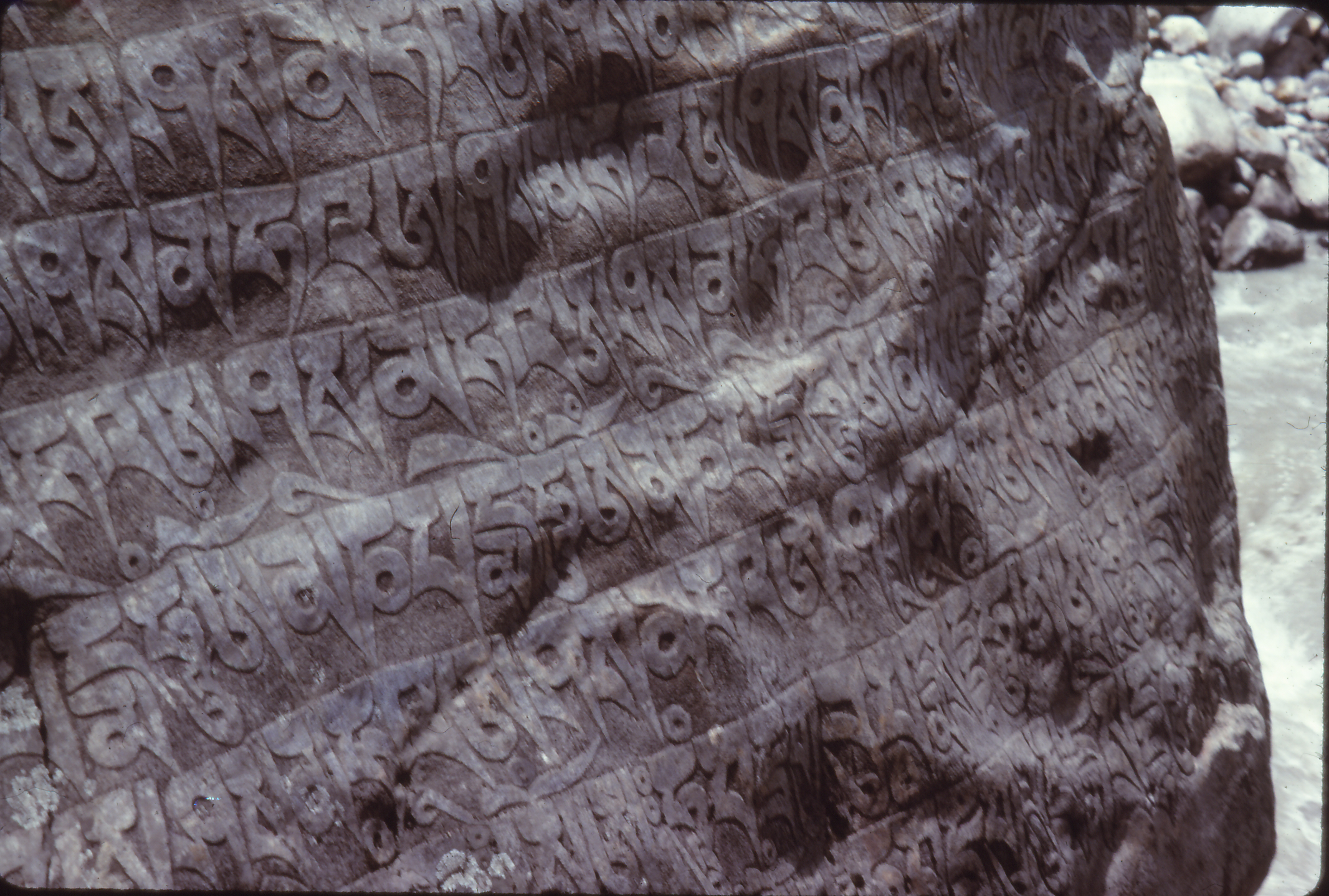
MANI STONES are found near paths, temples, villages and homes. They may be carved with a single mantra (chant) or a complete prayers to the god of compassion.
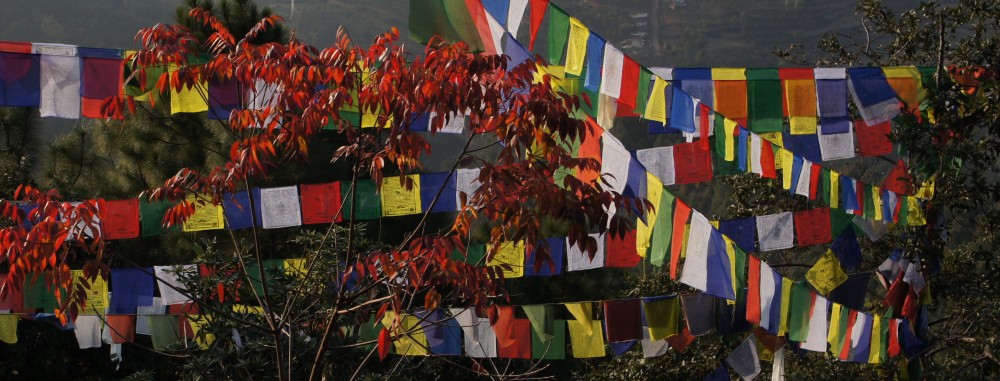
PRAYERS FLAGS are on roofs or mountain passes, strung across rivers and paths, or on tall poles. The five colours of prayer flags signify the elements; yellow, earth; red, fire; green, wood; blue, sky and water; and white, iron.

SONY DSC

Sagarmatha – Jomolungma – Everest

This mountain of many names has always attracted pilgrims, whether Tibetans honoring a peak they believe is the abode of a deity, or climbers and trekkers fascinated by the highest point on earth.  Sagarmatha is the name given by the Nepali government in the 1970s and the name Everest was given by the British in India.

“Jomolungma is the name of the mountain.  Jomo Miyo Lang Sangma is the name of the resident female deity.  She is a mother goddess and one of the five sisters of long life, so many pilgrims used to go to see her in Tibet.  Now, people, from all over the world, come to see Jomolungma, from Khumbu.”

“Jomo Miyo Lang Sangma rides on a red tiger.  This goddess is very pretty; she is orange and bright looking.  She wears a garland of flowers around her head and robes of many colors.  In Jomo Miyo Lang Sangma’s right hand is a long bowl of food and in her left a mongoose that spits wealth.” – The Abbot and Reincarnate Lama of Tengboche Monastery

Tengboche Monastery has been the heart of Sherpa culture since 1916

The Sherpas only started to establish celibate monasteries in the early 1900s.  Tengboche was the first celibate monastery in Solu-Khumbu and is a community of about 30 tawas (monks) under the leadership of the Abbot, Tengboche Rinpoche (Reincarnate Lama).

Construction of the monastery’s gompa (temple) started in 1916 and lasted three years.  The gompa has been destroyed twice, by an earthquake and a fire.  The 1990s reconstruction of the gompa attracted the support of Sherpa and international communities to this once isolated monastery

Tengboche is also known for the masked dances that celebrate the completion of ten days of prayers for the good of all beings.  For the Sherpas who come from many villages to attend, Mani Rimdu is a relatively recent tradition that started at the opening of Tengboche monastery in 1919.

It is performed at Tengboche monastery in the ninth month of the Sherpa calendar, which usually falls in November and at the Thame monastery in the fourth month.
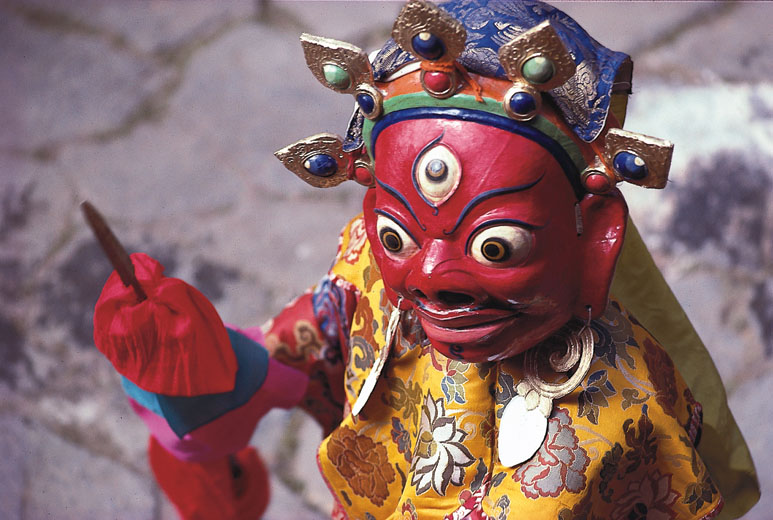
There are 16 dances performed at Mani Rimdu.  Tengboche Rinpoche explained the dances:
“Certain movements, sounds, smells, and sight can awaken our psyche and stimulate the states of awareness we describe as gods.   The dances are meditations that portray the gods and generate merit for everyone.”

Outer Changes and Inner Stability

The coming of tourists to the Khumbu Valley has brought outside changes and opportunities

Since the Nepali government first allowed westerners to visit the kingdom in the 1950s, the coming of tourists from around the world to see the highest mountain has brought a variety of changes both enhancing the livelihoods of the Sherpa people and affecting other cultural and natural aspects of Khumbu.

Tourism has grown to be the main source of livelihood for the Sherpas.  Since 1983 to 2019, the number of trekkers coming each year grew from 4,000 to 55,000.  The number of hotels in Namche grew from 5 to 100.  It was only since 1995, that families started constructing buildings to be used as hotels on the north facing area of the village.

Certain families and communities have had opportunities for education, loans, travel, and prosperity.  Others struggle with the inflation created by the growing demand for food brought by the annual increase in tourists.  Yet, the tourism economy of Khumbu sustains households as far away as ten-days-walk to the south east.

In Sherpa agriculture, potatoes are still dug by hand, and the traditional rules still regulate the annual herding of yaks. 

Changes in the Khumbu Valley include the bridges and trails.  Infrastructure growth has occurred in villages along major trekking routes with changes in traditional building materials.  The Lukla airstrip was built in 1964 to facilitate the construction of the hospital in Khunde by the Himalayan Trust.  In 2019, over 55,000 passengers flew in or out of Lukla, and hotels and services have been developed to serve them. Benefits include the places where the national park plantations have transformed bare hillsides to small forests.

While contact with outsiders has brought modern amenities, the Abbot of Tengboche monastery considers the changes in Khumbu:
“There are outward changes in our dress, houses, occupations and opportunities.  However, contact with westerners has not necessarily changed the Sherpa culture in terms of ‘inside’ culture – in what they believe and celebrate.  Sherpas, young and old, all do pujahs for naming children, weddings and funerals.  We celebrate Dumje, the Sherpa new year, and other festivals.  What is most important to us remains.”Part 3: The Wheel of Life

Sherpa religious and cultural rituals are generally unchanged  for the important events of life: birth, marriage and death

The “inside culture” of the Sherpas – how they mark life’s and the year’s important passages – remain relatively unchanged despite the obvious changes to “outside” aspects such as houses, clothes, and educational and economic opportunities.

Many households and communities will schedule important activities whether travel, rituals, weddings, and funeral rites on auspicious days of the week, lunar month, and year.

The genealogy of the Sherpa follows clans that descend through one’s father.  Tradition stipulates that one cannot marry within one’s own clan.  Marriage with someone from one’s mother’s clan is permissible, if the couple is not related within three generations.  Sherpas still strictly adhere to these proscriptions.

Sherpa Weddings

Wedding traditions are still followed very strictly in Khumbu and with minor modifications among Sherpas living in Kathmandu or even abroad.  There are several stages to a Sherpa wedding.  Sodene is the asking or the engagement.  Demchang is the establishment of a proper agreement.  Trichang sets the year and month of the final ceremony; Pechang is the consultation that sets the actual date.  Zendi is the final ceremony where the woman comes to live with the man.  The bride’s family gives presents and property that is her inheritance from them.

Sherpa Funerals

The Sherpa funeral rituals are strictly adhered to whether the deceased resided in Khumbu or Kathmandu.  When a person dies, lamas are called immediately to perform rituals to try to generate good, positive energy for the deceased.  There are many different customs, but, usually, the body is kept for three days then cremated.  The remnants of the fire mixed with clay and are made into tsatsa that are left in a chorten or under a large rock at the end of 49 days.

Every seven days after the death, special prayers are offered in the home of the deceased.  Within three or four weeks, the prayers called Shitro are done for three to fifteen days, depending on the finances of the family.  Every evening the family places an offering of tsampa on the fire’s hot coals for the spirit of the deceased.  The Bar-do for 49 days after the death is the time and space between lives, by the end of which the person’s next life is determined and they may be reborn.

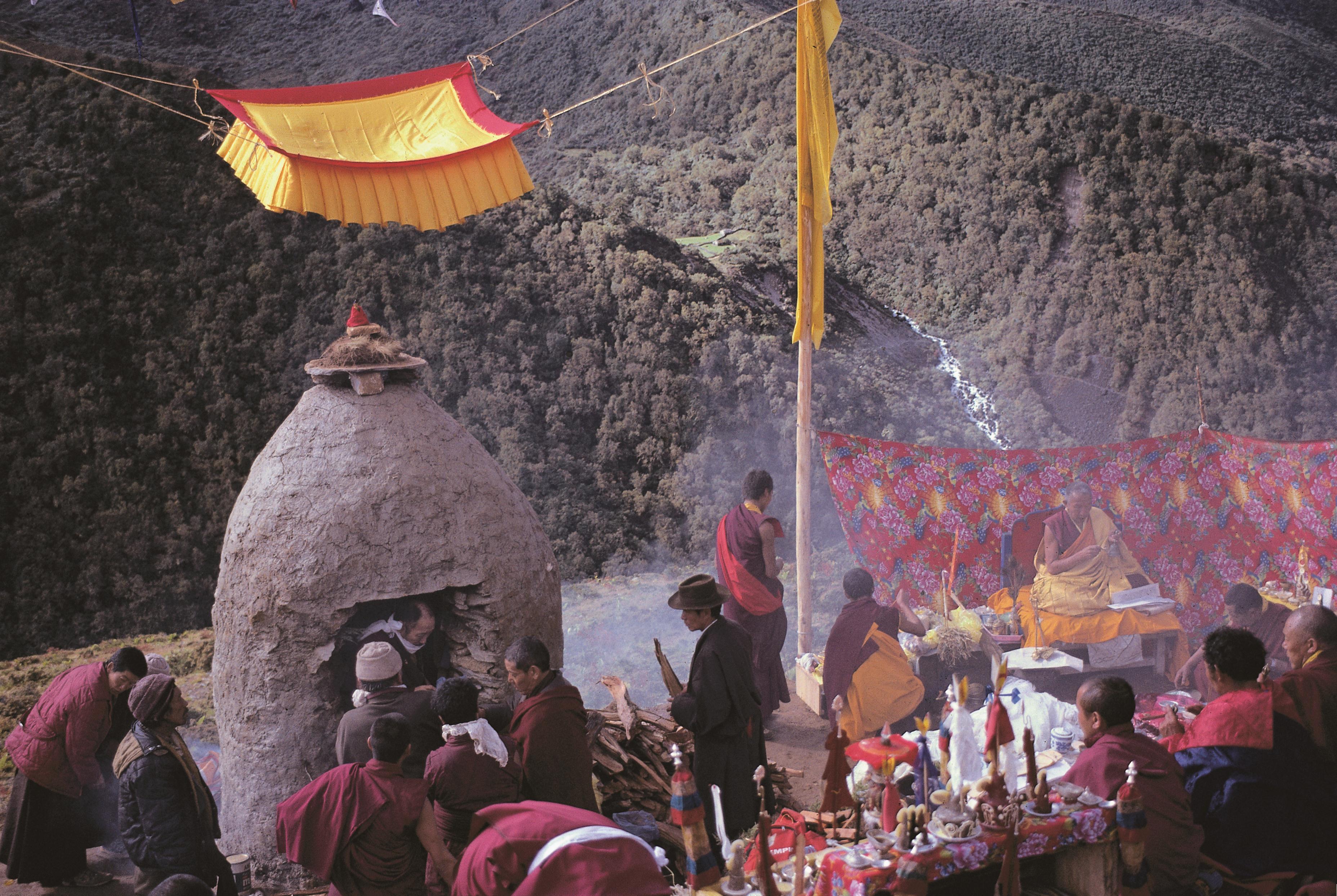
Special rituals are performed for high lamas and rinpoches, and the body is cremated in a special chamber.

These photographs are of the cremation of Dhui Rinpoche, a very important teacher who passed away in 1989 at the age of 86.  On the day of his cremation, his body was carried up the mountainside to a prominent ridge.

His funeral was a celebration of an accomplished lifetime.  Over seven hundred people came from as far away as six days walk.  His body was placed in the stone monument to be cremated as an offering.
Dumje Festival – A celebration of community spirit

The Sherpa year revolves around the main festival of Dumje celebrated in each village at the beginning of the monsoon in late June or early July.  Dumje began as a way to unite the newly settled villages after the Sherpas arrived in Khumbu.

Each year, eight households in a village have a turn, which comes about every sixteen years, to sponsor the festival.  Each sponsor provides food for the festivities according to their means.  Though this huge financial obligation may cause less affluent families to borrow substantial sums of money from lenders, most families see Dumje sponsorship as a worthy community involvement.

While in the past men from the village who had some religious training would prepare for the rituals, now the village invites and hires specialists, monks from the monastery to come and help prepare for the celebration.  Also whereas in the old days, the most learned of the lay lamas (ministers) would officiate and lead the prayers, now the heads of the local monasteries would come to a village.

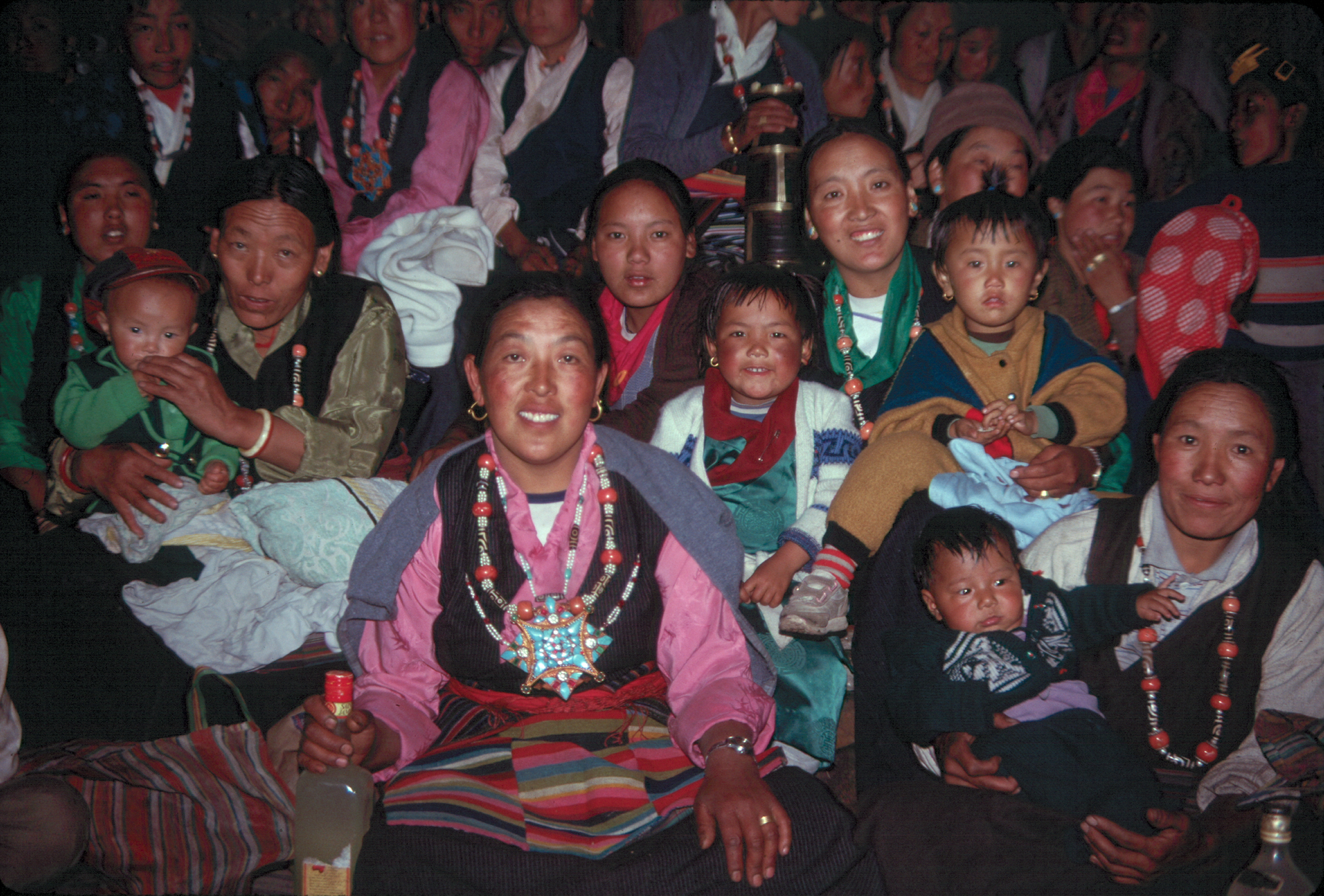
“We pray together, we dance together and we eat together.  What is important now, at Dumje, is that we are all here cooperating together”

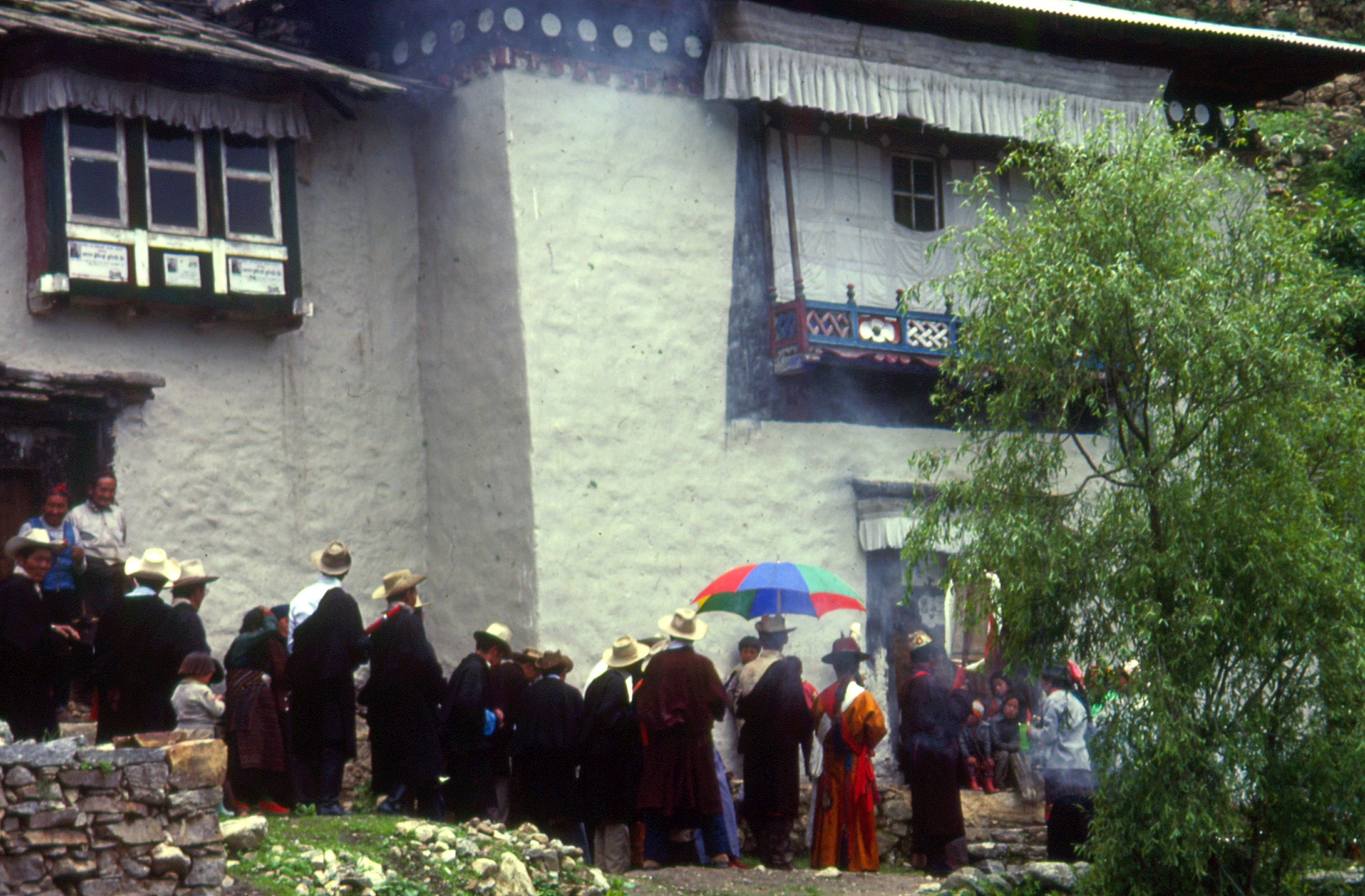
The men of the village gather for prayers to Khumbila start the festival.  They put up new prayer flags, share chang (rice beer), do traditional Sherpa line dances, and throw tsampa (barley flour) for good luck.

The cowboy hats were adopted as fashionable wear by Tibetans and Sherpas after members of a 1905 British expedition to Tibet wore Stetsons.)

MUSTANG – trees to temples

Dust and blowing sand

Standing in the middle of the sandy trail with the wind howling, the sun blazing, no shade and not a tree or shrub in sight.

“From right here, 700 years ago, the Lo kings cut trees for the gompas in Lo,” says Chimi, our guide.

The only trees we’ve seen in four days of walking are those planted near irrigated fields in villages, oases of green in this rocky, barren, desolate landscape. Eroded bones of the  earth. Canyons out through the layers of rocks lay down over the millennia as sediments on the floor of an ancient sea. Rocks in reds, rocks of beige, a few striped rocks with  green argallite. Rocks, sand, canyons, and sky.

“For those huge pillars? ”

“Yeah, this all used to be a forest of big trees. It’s in Khampo Tashi’s book.”

Those pillars, those huge pillars at least 3-4 feet in diameter and 25ft high are so magnificent. Many came from a single piece of wood …  That would have come from this desolate place. Huge timbers that must have been cut from even larger trees.

Larger trees that grew until 700 years ago in this now barren high desert.

A forest where it is now high altitude desert. What happened?

Mustang is an old place for the Nepal Himalaya. People have perhaps lived here for 6,000 years – at first in caves  cut into the sandstone cliffs. Gradually, Lo became the walled capital of the Lo kings.

A walked city like none other in the Himalaya. More and more building with growing affluence from the salt trade, more gompas and monasteries. At the pinnacle of the Lo dynasty and culture, three huge gompas were built of stone, rammed earth and wooden windows, doors, and pillars. Huge pillars to hold the heavy building. And they came from a forested valley that is now this desert place.

The speed of the change both intrigues and depresses me. I no longer find Mustang a fascinating desert landscape but a denuded land.

A traumatized land where demons and saviours (Guru Rinpoche) fought over bringing Buddhism to Tibet and the Himalaya. Where the slain demons blood is believed to colour the red rocks of the region.

Later talking to the forestry professor stranded in Jomsom, I learn that when trees are cut, their roots no longer have the capacity to hold up the water table so the water drops deeper. Only those trees and shrubs close to irrigation canals or streams can survive.

Why do we keep cutting so many trees?

Monsoon Summer in Khumbu

Pic08 copyright

A chapter from Gaiety of Spirit about a visit so long ago… 35 years. Now, fewer and fewer Sherpas keep yaks.

Heavy mist obscures the mountainside where I wander along an overgrown trail among fences of stone. The mist and thick, damp grass muffle all sound as I search for the stone hut where I have been invited to spend the night. The tiny settlement appears deserted except for a few shaggy yaks.

An elderly lady appears in the fading light, wading through a field of wildflowers and grass. It is a relief to see my friend’s mother, Ama Yangin. In the Sherpa language, ama means mother, and everyone calls her that out of respect and affection.

Entering the tiny door of her hut, I bend double and leave my damp pack in the anteroom where supplies and the remnants of last year’s hay were stored. In the main room, benches that doubled as beds line the walls around the hearth.

Ama Yangin poured milk from the wooden barrels into a large metal pot and quickly set about preparing us tea. Sitting quietly by the hearth, warm and dry after being damp outside, we watched flames lick the tea kettle and each seemed absorbed by our own thoughts. Despite the rain that started outside, we are warm and dry by the hearth.

In the eastern Himalaya, the summer monsoon lasts from June to September. During this quiet but productive season people carry out the chores of herding and farming with calm dignity and quiet purpose. Farming is not easy on these mountains, but almost everyone, including businessmen, owns plots of land on which to grow potatoes, buckwheat, or barley to feed their families.

Most fields for cultivating food crops are at relatively lower elevations of about 3300 meters near the main Sherpa villages. During the cold winter, herds of yaks are grazed on nearby hillsides; when the summer comes, the yaks are taken up to high valleys where the rains have changed the dry mountainsides to rich, green pastures.

I marvelled at the contrast seen in this valley between the summer monsoon months and the rest of the year. Surrounded by snow and ice mantled mountain peaks, the Sherpas’ valleys transform with the seasons. In autumn and winter, when almost all tourists visit, the land is dry and barren with not a blade of green grass to be found. Snow often blankets the valleys after winter storms.

Summer rains color these valleys unimagined hues of green. Hillsides become carpeted with lush, green plants and wild flowers. Monsoon is a gentle season in the mountains; the rain and humidity are less intense than in the lowlands and colors are muted by the misty skies. Though there may be several days of clinging mist, the sun does sometimes shine in the monsoon.

Many days dawn clear. The hills vibrate with color and the mountain peaks sparkle with fresh snow. Clouds form rapidly in the lowlands. Rising, they first envelope the peaks and then fill in the valleys by noon. Mist becomes drizzle and then rain by late afternoon and evening. People time their activities to the daily weather patterns, retreating indoors as the afternoon rain begins.

Despite the weather, this is a favorite time of the year for the Sherpas. Those who have moved to Kathmandu wistfully compare the cool, green mountain monsoon to the hot, muggy summers in the lowlands. Since most visitors avoid traveling in Nepal in the monsoon, many Sherpas who work as guides and porters return to their homes in the high country.

Ama Yangin offers a plate of hot potato pancakes. After we eat, Ama Yangin talks about two of her sons. Both are far away from Khumbu; one works on climbing expeditions and the other, a graduate of a foreign university, works for the national park. From Ama Yangin’s questions, I realize she cannot imagine how they spent their days on expeditions or in offices.

The pace of her days in the summer pasture is steady and predictable — fetching her animals, milking the females, heating the milk and making it into yogurt and butter. Between her herding chores, she fetches water, cooks, and looks after her grandchildren.

This maze of fields, stone walls, and huts was an oasis of habitation amidst isolated, sprawling valleys at 4300 meters. Sherpa families use these valleys as summer pastures for their yak herds. The shaggy bovines provide dairy products, wool, transportation, and perhaps an excuse to spend three months in these mountain meadows.

From her main house in the village far below, Ama Yangin has brought just enough to meet her simplest needs. Only essential kitchen utensils line the shelves on the far wall. Though she stays here alone, her eldest son with his wife and children are in another hut just across the hay field. They help Ama Yangin with her heavier chores and she keeps an eye on the younger children. They visit in their huts several times a day. Sharing a few moments together seems just as important as tending the herds.

Slide05 copyHer hands were busy even as she sits. Those who spin wool, work at it continuously during the monsoon. Wool is plucked from the yaks in the spring, then beaten and rolled by hand into loops, which are coarsely spun by the men. Women do the final, fine spinning. Eventually the yarn is woven into long narrow panels that are sewn together to make striped brown-and-gray blankets for sleeping.

The next morning Ama Yangin rises before dawn to start the fire and brew the traditional butter-salt tea. After three quick cups of tea, we ventured out to the corral where her female animals and their young are tethered for the night. She deftly binds the rear legs of a slightly perturbed nak. Talking gently, she squats beside it and coaxes the milk from its udders into the wooden bucket.

“How much milk does a yak give each day?”
Ama Yangin laughed and giggled. I mentally reviewed my Nepali phrasing to make sure I hadn’t just embarrassed myself.
“Yaks don’t give milk,” she chuckled, “yaks are the males, we call the females NAKS. …That’s why we Sherpas laugh so hard at foreigners asking for Yak Cheese.”

She describes the sex and parentage of her animals: three yaks, seven naks, ten yakbees (the young of the species) and several dzopchioks — male crossbreeds that are sterile and are used as pack animals, especially on trips down to the warmer elevations which the high-altitude yaks can’t tolerate. Female crosses are called dzooms. They produce milk that is almost as rich as a naks, and in greater amounts.

In the trekking season her male animals, the yaks and dzopchioks, are sometimes hired out to carry loads for trekking groups. Besides being a traditional status symbol, yaks are a good investment of the family’s earnings from trade or tourism.

Ama Yangin explains that she first makes the milk into yoghurt so it will keep for three or four days until she has enough collected to churn it into butter.

“The butter has to be churned enough to squeeze out all the buttermilk. Then it should keep without smelling for a year. In a good summer, I might make enough butter for my family’s needs and have some extra to sell to a tourist hotel in Namche.”

Owning a herd necessitates having pastures away from the main villages.

“Our traditional Sherpa rules prohibit us from keeping livestock at the main villages during the summer while the crops are growing,” explains Ama Yangin. “It’s in everyone’s interest not to have animals breaking into fields and devouring the crops. A hungry yak can quickly destroy a potato field.”

Some families have huts at three or four pastures in the higher valleys where there are grazing areas of rich grass during the monsoon. They move from their spacious homes in the main villages in late June just as the rains begin. “We shift our herds to a new pasture at least twice in the monsoon. It depends on the size of the valley and when the grass is at its prime in each place.”

Slide034 copyBy fall, the herds have thoroughly grazed plants on the high pastures. Some fields are walled to protect grass that will be cut for hay to feed livestock during the winter. The field in front of Ama Yangin’s hut is knee deep with pale blue fleabanes, golden ragwort, and bright yellow cinquefoil.
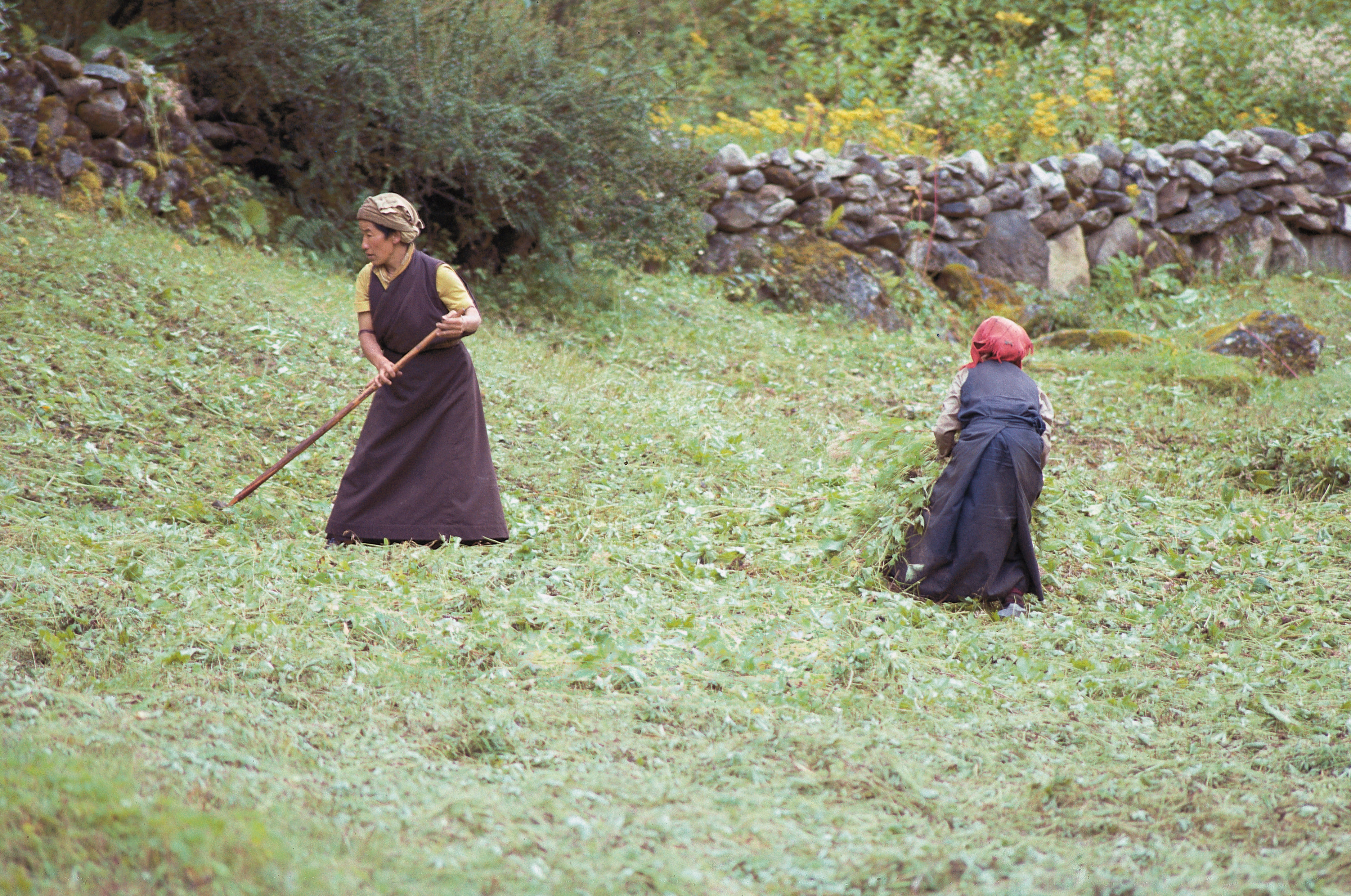
The morning is clear and bright — good conditions to cut and dry the grass for hay. The eldest son and his wife wield a scythe in each hand, mowing the grass close to the ground. Ama Yangin and her two older grandchildren follow with wooden rakes, gathering the cut grass and piling it into stacks, filling the air with the scent of freshly cut grass.

After two hours, everyone takes a break, sitting cross-legged in the grass, consuming cups of tea and two pots of boiled potatoes dipped in chili sauce.
The grass cutting ends as the late afternoon drizzle began. Ama Yangin went off in the gentle rain to milk her naks and dzooms. Finally retreating indoors as the rain pours down, we repeat last night’s routine of tea, potato pancakes, and conversation.

The next morning, the sun is bright and clear. Except for the vivid green of the near hillsides, this could have been a day in the dry, clear winter. Though I have a long day’s walk ahead of me, I linger.

“Don’t forget,” reminds Ama Yangin, “Walk early in the morning, before it rains.”

Bonded Labourers – ‘What Little We Earned’

When the Kamaiya (bonded labour) system of southwestern Nepal was abolished in 2001, the government promised them land, by creating camps for the freed Kamaiya on government land here each family was supposed to receive its own small plot. Several aid agencies started work with these thousands of people – literacy, food-for-work projects, vocational training, and microfinance. During work for one of these organizations, I was interviewing freed Kamaiya and met Kalamati.

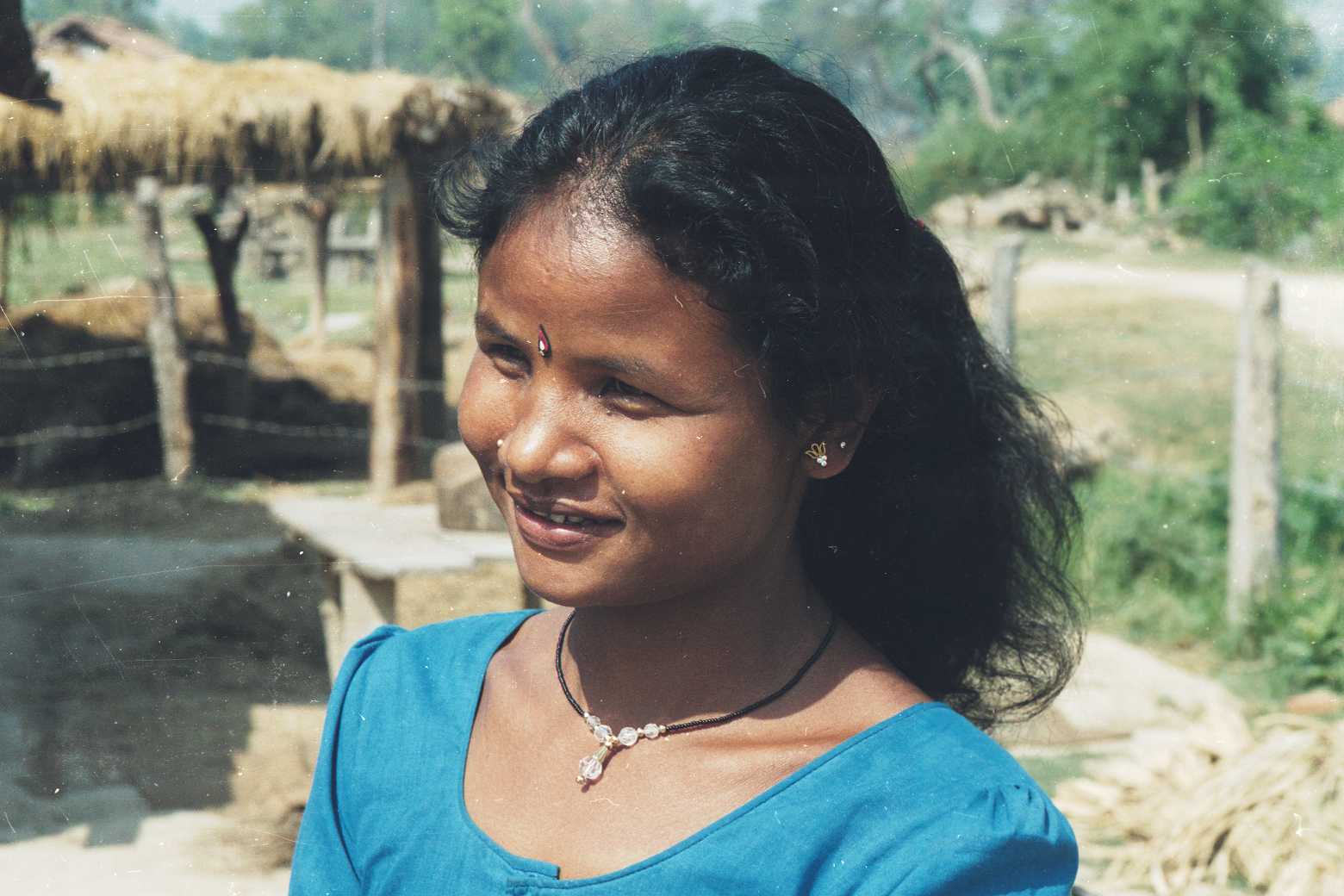
Kalamati was a bonded labourer (Kamaiya) for most of her life as her family had had a debt with a property owner for several generations. Despite being released from their inherited debts, her family and many of these people continued to struggle for their daily existence.

“Before, (as bonded laborers) we had to work from morning to night, and never had time for our own development. Now, we can make our own decisions and have our own piece of land.”

The crux of their situation was financial – anyone whose family might have had to take a loan from a landowner in the past. The system started during the settlement of the Terai by migrants from the hills. One landowner said that at the time, many of indigenous people, mostly Tharus, were interested to work the land “under the guardianship of the landowner”. When asked how much debt it took to bind a family for life, the answer was surprisingly little – Rs 15,000, 9,000, or even less. (about $300)

Scan34Layakpurcamp2marketing herbs  bani campManehara Camp#005WomanSittingScan52

Even people of other ethnic or caste groups would become Kamaiya if they lost their fields and needed a loan from a ‘zamindar’ (landlord) to buy food. We interviewed a Magar ethnic woman from the hills whose family lost their land to the local moneylender and a high caste man whose parents’ fields had been lost in a flood. The system was institutionalized economic exclusion of the vulnerable who needed a loan.

Families with any size of land holding usually had a Kamaiya family to work the land in return for food and meagre ‘daily wages’ as repayment on the loans. One young man working with us had grown up with Kamaiyas working for his parents. He had questioned the inequities from a young age and joined one of the activist groups lobbying for their release. We heard a story of a generous widow who owned only a small piece of land. She borrowed money from the bank to repay a large landowner the debt of the one Kamaiya working on her land. However, when the government absolved the Kamaiya debts, she still had to repay her loan for the Kamaiyas to the bank.

Some freed Kamaiya have succeeded in earning a simple living by operating shops, learning a trade, raising livestock, or growing and selling vegetables, many have still had a difficult time earning enough to survive. Others were reported to have had to mortgage their children back into bondage as child labourers in order to obtain loans or annual salaries from which the rest of the family could buy food. Many still work on the landlord’s fields but now for regular wages of Rs. 70-100 per day. One man we had interviewed said he calculated that in the past as a Kamaiya, his father had earned only three rupees per day.

In one camp, the men told of working in a sugar factory in Bardiya where they earned Rs 20 per day. The mill was owned by the family of a four-time prime minister. How can Nepal ever change the relationships between the rich and the poor when its leaders continued to assume an attitude of ruling rather than governing and serving the people.

Other people told of having to go out in the fields at night to beat the crops and scarred away insect pests; they had to pay for the kerosene in the lanterns themselves – even though it was the landlord’s crop. When they did not have enough money for kerosene, the landlord loaned it to them, adding to their already overwhelming debts.

The oppression went further for the women expected to work in the homes of some property owners. “It was much harder for the women,” said one older woman. She went on to describe how the ‘tradition’ of young women being expected to sleep with some landlords on the night of their wedding, usually to another Kamaiya, had led her daughter to go join the insurgency as her only means of rebelling. It was 2002. The insurgency was spreading over rural Nepal. We had to leave. Bardiya(Jainpur) # 17 Bardiya(shantinagar) # 29 BoyInFrontHouse FamilyKitchen kaiali Maleketi women 02mar  Manehara Camp#004    WomanChild  Women Participants4_Kailali_UG 3Women  Bardiya(Jainpur) # 14Bardiya(Jainpur) # 15

shop Maleketi camp 64Scan Maleketi camp 63Banke (Muktinagar) # 05

A risky living

“If the avalanche had been about an hour later, I would have been right there and so would have been about a hundred more people,” says Pemba. “I was just about to leave base camp!”

Twenty years ago, Pemba had often been the cook on treks I was leading. Since about 1998, he has worked as a high altitude cook on Everest expeditions.

“I prefer expeditions to trekking because I make more money. Otherwise, my wife and I have just a small potato field and this little teashop. Without the expedition money, we could not afford to buy rice and staples at the market – everything has become so expensive!”

Besides, he adds, there are now very few jobs as cooks on treks since most trekkers stay in the many hotels and lodges that have sprung up along the trekking routes. In the decades prior to 2000, trekking groups stayed in tents with own cook and kitchen crew, guiding staff, and porters. With many groups coming with just a guide and porters, the jobs with trekking groups dwindled.

It was about the same that commercial expeditions started on Everest. With several expeditions attempting Everest each season, the demand for expedition workers boomed. At least 400 Nepalis of various ethnic groups, especially some Sherpas, work as high altitude climbers, guides, cooks, porters, and kitchen staff each season.

It is an occupational option, often taken by those Sherpas from poor families living away from the main trekking routes. They just do not have the capital or opportunity to start a hotel, or the education to work in another profession. One Sherpa from a poor family said he was in a fix when his wife demanded that he stop working on expeditions. Luckily for him, an uncle offered a small piece of land and a loan to start a hotel on a newly popular trekking route.

However, for many like Pemba, they may feel that they have fewer options to make money other than expeditions. “I could work in a hotel and one of my bosses at the company said that he would help me to get special training as a chef. But, I would have to work twelve months a year to make the same as I earn in three months on an expedition.”

His wife adds, “Those three months… the whole time I have a knot in my stomach and ask anyone coming down if they have seen Pemba.”

He admits that it is a risky way to make a living. I ask if he has attended the Khumbu Climbing School held each winter to train Sherpas and Nepalis in technical climbing safety. “No, I’ve not gone because I only go through the icefall twice each expedition, once up to Camp 2 and once down.”

Pemba leaves the kitchen for a moment, returning with a small red pouch. “These amulets, relics, and blessing cords from the lamas are all very potent. I have all of them blessed again each year by the lama in Pangboche as I go up for an expedition. I wear it under my clothes the entire time I am on the mountain.”

When I ask if he will go on an expedition again next year, he says, “Of course I will go, how else will I buy food in the market. But it is true, that it would be a lot less risk to my life to go get a job cooking in a hotel.”

DSC02977

Why did some Sherpas first go on expeditions…

On this anniversary of the first ascent to the summit of Everest, let’s pause a moment to remember why men from the Sherpa ethnic group in Nepal first went off to work on expeditions.

Kancha Sherpa is the last surviving member of that 1953 expedition, perhaps because he was very young when he went off to Darjeeling in search of expedition work. Kancha told me his story in December 2009 in Namche.

“When I was a kid we were so poor, we had no mattresses just yak skins and the wooden plank for a pillow. We used to walk to Kathmandu in 8 days, carrying tsampa cause we had no money to stay in hotels.

“We carried loads to Tibet. There were three people who traded Nepali paper to Tibet to use in the prayer wheels. We earned Rs.5 to carry 30 kg loads for the 4-day trip to Kyabrak, just over the Nangpala. The Tibetans would pay us in salt – 8 pathis (30 kg) that we carried back to Khumbu in three days. Then we carried four pathis at a time to Kharikhola where we got three parts of corn for one of salt – so we could not take too much salt at once to be able to carry the corn back to Namche.

“Then we dried and ground the corn to eat. Then we started the whole circuit all again. The paper was made in Karikhola and they brought it here to sell. There was thick and thin paper for the inside of prayer wheels and pecha (religious books). At the age of 13-15, I would go 11 times a year over the pass. We were walking on snow for about an hour at the top of the pass.

“I first went to climb in 1953. Three friends and I decided to go to Darjeeling to see if we could get work on an expedition. While my mother was out with everyone dancing in a potato field, I hid some corn flour in one of her shirts. My friends each had Rs.15 and 20, but I had none so I took the corn for us to eat. We left at night and got to Chaunrikharka at day light -looking over our shoulders to see if our families were coming for us.

“It took four days of walking over the hills to get to Darjeeling. We met a woman from Thame village there, carrying a load of vegetables. We asked her where Tenzing’s house was. She took us to his little house. He asked who our fathers were and since he knew my father, he took me in to work while my friends found work elsewhere. Tenzing liked my work cleaning and getting firewood so he said he would take me to Everest in a month. I was so happy, I carried even more firewood.

“Then I worked on expeditions until 1973, when my wife asked me to stop as so many friends had been killed. I liked the expeditions cause I got clothes and money.

“During these years, 1953-73, I would also earn more money by buying western watches in Calcutta with loans, and selling them in Tibet. One time in Shakya, I was caught by the Chinese army, who took all my watches and money. We were stuck inside the jail for a week without any water. My older brother was in jail in Lhasa because they did not know who was Tibetan or Sherpa. I had a letter written and showed our Nepali passports. Eventually, we got back here.

“Afterwards, I started working trekking. Since I can only write my name, Kancha (Tenzing’s little daughter taught me in 1953), I’d keep accounts on trek with my beads and have someone who could write make notes.

“Now, we earn money here and don’t have to go away. The kids whose parents have earned well with hotels all have good educations. Now, the Tibetans all come here to trade and earn money. Now, I’m an old man doing my prayers.”

DSC03108